How To Coach Defensive Backs: Techniques, Reads, & Fundamentals
Inside, you'll find coaching resources to help you coach the fundamentals, techniques, and reads needed to build elite defensive backs.
These resources were built for youth and high school coaches who coach defensive backs and want a progression system for teaching the following: footwork, reads, block destruction, ball disruption and tackling.
If you want to accelerate your learning with video instructions and guided help. Check out vIQtory Pro below.
Core Defensive Back Skills
Below, we're going to cover the 5 core defensive back skills that every player should master to have a direct impact on the game. Coverage is important, but the ability to tackle in space, get off blocks, and set edges are just as important for a cornerback.
Footwork
Starting with footwork, it's the most important aspect of playing defensive back. This applies to both the safety and cornerback positions. As a coach, it's important to teach the first step and weight distribution. What we mean by weight distribution is where the player's weight is when they start to backpedal. If it's over their hips, they will take 3-4 extra steps to transition. Here's a visual example of what we mean.
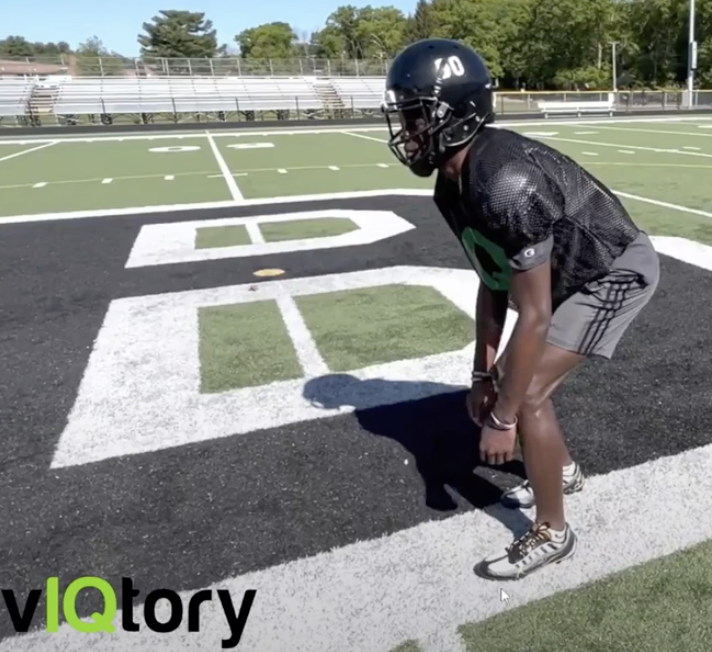
If you notice, the player's chest and chin are over his knees. On his first step, it should remain that way. If their chest comes up and their hips start to move forward, that means all of the player's momentum is going backward. Remember, the goal of the backpedal is to read what is going on before making a break.
The defensive back should be in the backpedal for no more than 3 steps on a run, and if they are being pressed by a wide receiver, they can start to tempo their backpedal.
Ideally, the defensive back should never be in a full-speed backpedal. The stance and start are the most important techniques of playing defensive back. This is the core foundation of any cornerback or safety.
Reads
Next are the defensive back reads. In order to properly read whether it's a run or a pass, the defensive back must process the information during his backpedal. There are two main ways for defensive backs to read whether it's a run or a pass.
The first way is by looking at the quarterback and the running back. This is the most common way, as defenders can get immediate feedback on whether it's a run or a pass based on what the quarterback does. The downside of this, however, is that if it's play action, they will react wrong.
The rule of thumb is to be 100% certain it's a run before running up to play it. It's good to be late to the run, then to be early and get a pass thrown over your defensive backs.
The second is to read the end man on the line of scrimmage (often referred to as EMOL). The end man on the line of scrimmage, often the tackle, will tell you if it's a run or pass. If it's a run, they will fire out and run block the defensive lineman. If it's a pass, they will pop up and block the defensive end. This can help give your defensive backs a read on whether it's a run or a pass; then they can transition their eyes to the wide receiver who's trying to block them or run a route.
Block Destruction
Block destruction is a key skill for any great defense. Cornerbacks often get the stigma that they are not good tacklers. We have to change that mindset and make both cornerbacks and safeties elite tacklers. In order to do this, they must understand how to get off blocks.
In order to get off blocks, you can't be afraid to get on them. There are two main types of ways for defensive backs to get off blocks.
Arm Over or Rip - This is typically coupled with colliding with the receiver first, then using his leverage against him as the defensive back pushes, pulls, and then finishes with an arm over or a rip action.
Head Fake - If your defensive backs are quick and they don't need to take on contact, then they should try to avoid the block that's coming at them. In order to do this, they should make a head fake one way, then cut hard in the other direction.
Regardless of the technique being used, cornerbacks should never be blocked by a wide receiver, and the same standard goes for safeties in open space.
Ball Disruption
When coaching ball disruption, it's important to teach it in two phases: in-phase and out-of-phase. What are these two techniques?
In-Phase - In-phase is when your defensive back touches the wide receiver. This means they can look back for the football because they know exactly where the receiver is. When they are in phase, they want to push the receiver to the sideline by slightly leaning on them with their shoulder to alter their route. Jump up and catch the ball for an interception or punch through the hands to disrupt the ball.
Out of Phase - Being out of phase means that your defensive back has lost leverage on the initial coverage. This means they are typically chasing the wide receiver. I like to tell our defensive backs, "Just because you lost leverage doesn't mean you lost the route." When your defensive back is out of phase, they are strictly focusing on the receiver's hands. When the hands go up, the defensive back should punch through the hands of the wide receiver to disrupt the catch.
Tackling
The last phase is tackling. Ensure your defensive backs know how to tackle from both inside-out and outside-in angles. Make sure they know where to put their head to protect themselves, as well as how to properly take down the ball carrier.
On top of form tackles, the defensive back should also know how to clip an ankle to make a touchdown-saving tackle. Cornerbacks are often the fastest players on the field and will be able to chase down the running backs who break through the line of scrimmage. Teaching them disadvantage or back-angle tackling is another skill set for them to learn.
Coaching Install Progression
This is the order we found works best for installing your techniques and fundamentals with your defensive backs. These progressions can start as early as the off-season, preseason, and into week one. If you're starting during the season, then we recommend picking one skill a day and introducing it slowly to your players. Throughout the year, the players should sharpen their skills each day.
Steps To Install | Coaching Points | Player Progression |
|---|---|---|
Step 1: Stance & Start | Stance, start and alignment. Introduce read steps. | Players should start to feel comfortable in their back pedal and should know how to align in your base coverage. |
Step 2: Coverages | Coverages and how to play man & zone coverage correctly. | Teach your players how to play both off-man coverage and press coverage so they are comfortable running with WRs. |
Step 3: In-Phase & Out Of Phase | Teach your players how to play in-phase & out of phase when the ball is thrown. | Players should feel comfortable playing the ball in the air. This includes when they are in position & out of position. |
Step 4: Tackling | Learn how to block destruct and tackle from the outside-in. Teach players how to take the appropriate angles to the ball carrier. | Players should be aggressive and not shy away from contact. This includes disengaging and making tackles on the perimeter. |
Common Mistakes Defensive Back Coaches Make
Teaching Drills Before Teaching Backpedal & Reads
The first mistake that defensive back coaches make are running backpedal and break drills before teaching the players how to get in a proper stance & start, as well as what to look at. The feet and the eyes have to marry each other when the play starts. Start with a proper stance, make sure the weight is evenly distributed and then transition the eyes to the target.
Backpedaling For No Reason
Too often young defensive backs are so worried about getting beat deep, that they fast backpedal into space for no reason. This means the defense has no edge set, and the opposing team can run toss sweeps and jet sweeps to their advantage. Once the defensive back gets their read steps, transition to the run or pass.
Coaching Cornerbacks & Safeties The Same Way
Cornerbacks and safeties are similar in a lot of ways. They both require the same skillset when the ball is in the air. However on run plays, they are very different. Their angles are different when tackling and their footwork is different before the play. if you need them in the run support, use scooch steps with your safeties and slow tempo back pedals for your cornerbacks.
Only Practicing Tackling From The Inside-Out For Cornerbacks
Cornerbacks are the one position on the field where most of their tackles will be done from the outside-in. However, most drills on social media focus on inside-out tackling. Cornerbacks need to know how to position their head and how to make effective contact on the ball carrier.
Get More Drills & Video Instruction Inside vIQtory Pro
The Full Defensive Back Install: Get drills and video instruction on how to coach defensive backs. Inside you'll find a library of drills, progression on how to coach your position and game plan tools to put it all together on game day. Built for youth and high school coaches.
Coaching Resources
©2026, vIQtory Sports . All rights reserved
Follow Us