Tackling is the single most important defensive skill in football. It’s also the most misunderstood and taught incorrectly.
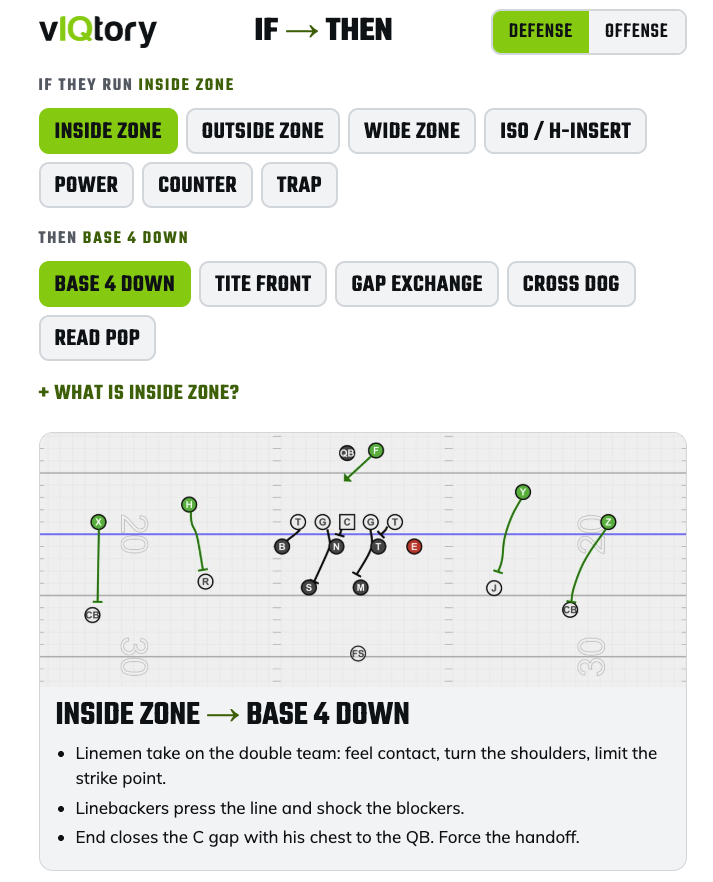
Free Play Calling Guide
Know the exact play to call in every situation
- Pick the front you see. Get the plays that beat it.
- Pick the play they run. Get the stunt that stops it.
- Tap-to-answer tool for the sideline, plus the PDF for your binder.
Too many youth coaches treat tackling as something kids either “have,” or they don’t. Remember, tackling is a technique, and like any technique, it can be taught, drilled, and perfected.
When you coach it right, it also means that you coach it safely. That is going to be the goal of this article. How can you teach your players to tackle safely? That matters more than the big hits.
Here’s how to build tacklers from the ground up.
Teach Safety First
Before you ever teach a stance or a drill, establish this rule with your team: we tackle with our heads up and out of the tackle, always.
When we (us coaches) were kids, we were taught to put our heads across. By doing this, we often put our heads directly in the line of fire: running backs are at their most powerful when their thighs move forward.
Neck injuries are preventable when the proper technique is taught correctly.
Make it a zero-tolerance standard from day one. When you see a kid drop his head, you stop the drill, you correct it, and you reinforce the right way.
Tackling Fundamentals
Don’t teach tackling as one big explosive movement at first. Break it into individual pieces that kids can practice slowly and build up to full speed.
At vIQtory, here’s how we break down the tackle in 4 phases
Phase 1: Building Confidence
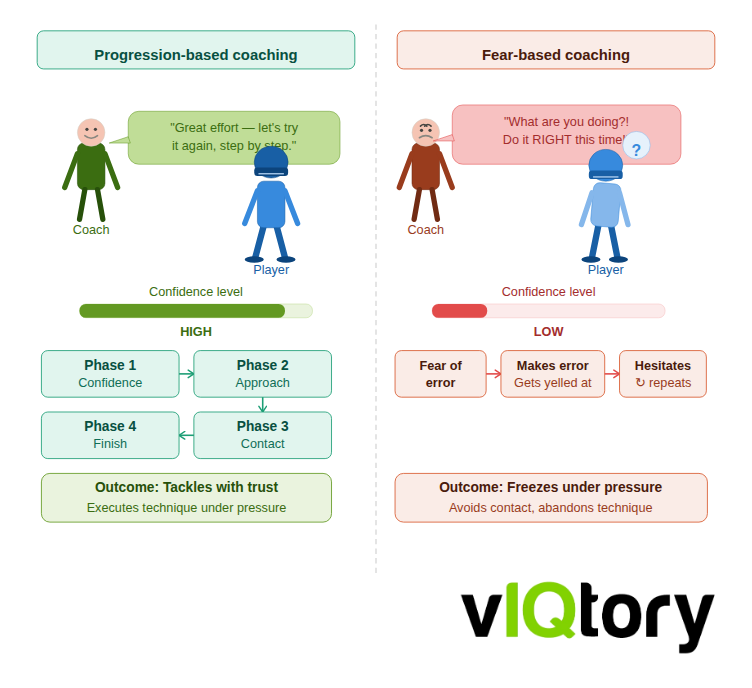
This is one of the most undertaught things in football. Coaches assume their kids are either tough or they’re not.
That’s not the case. Becoming a great tackler is all about confidence. The best analogy I use for coaches is to picture yourself in a fist fight or even in any sort of conflict. If you’re confident in your abilities, you’re less likely to be scared or worried when it arises.
If you’ve never been in a fight before or are not one for conflict, you will naturally shy away from it. It’s no different when teaching tackling. Confident players have no problem sticking their shoulders on the thighs of other players. We must teach our players to be confident and reward or cheer them on as they progress.
Next, teach in progression. Don’t just line kids up in hitting drills. Here is the progression your players should take:
Step 1: Tackle Bags From Knees
Step 2: Tackle Bags From Standing
Step 3: Tackle Bags While Moving
Step 4: Tackling Players While Stationary
Step 5: Tackle Players While Moving
Notice how in every phase we are building confidence in the player (and their bodies) that it’s ok to hit the ground and it’s ok to drive your shoulder through their thigh. This helps to build confidence.
Phase 2: Approach Phase
This is where 75% of tackles are missed. Poor angles and leverage often relate to missed tackles.
As the defender closes on the ball carrier, he must break down into an athletic position: feet slightly wider than shoulder-width, knees bent, weight on the balls of his feet, back flat, and eyes up. Tell your players to look at the hips. This will be the contact point.
Shoulders shake, feet stutter, helmets move, but the hips and thighs tell you exactly where the body is going. Keeping eyes on the midsection also naturally keeps the head up and out of the tackle, which is exactly where you want it.
There’s a simple rule for leverage: If you’re inside, stay inside. If you’re outside, stay outside. If you’re head up, regain leverage by moving left or right.
The coaching term “near foot, near shoulder” comes into play here. All this means is we want to take the shoulder that is closest
Phase 3: Striking Phase
Just before contact, the tackler should go from a long stride (running as fast as he can) to a short stride (quick, choppy step). This keeps his center of gravity low, keeps him balanced, and allows him to mirror the ball carrier’s last-second movements.
When striking, place the head to the side of the ball carrier, and squeeze the thighs as tight as possible. Coach your players to drive through the ball carrier, not to him. The goal is to stop him where contact is made, not 2-3 yards behind the ball carrier.
The player who is flat-footed with his feet wide at contact will get run over. A player whose weight is forward, with his shoulders low, and buzzing is in control.
Phase 4: Finish Phase
When contact is made, the tackler still has one more job left. They need to keep running their feet. What happens when force meets force is that it will often stall (or stalemate). Meaning, there is no winner on the initial contact.
However, the player who is still running their feet will ultimately win the contact.
If the running back is still running their feet = they will win the rep
If the tackler is running their feet = they will knock back the running back
Emphasize: “Run through the tackle, not to it.” The goal is to finish past the ball carrier, not just stop at him.
Common Mistakes and How to Fix Them
Mistake 1: Head down at contact
Fix: Coach players to “See what you hit.” If they can read the ball carrier’s jersey number at contact, their head is in the right place. Make it a game for your players. Can you call out the number right before you make the tackle?
Mistake 2: Arm tackling (reaching and grabbing without body contact)
Fix: This happens when defenders have poor approach angles or are too flat-footed. Drill the buzz step and the foot drive. Then make sure you are doing approach drills, so players can track a moving body. This could be an easy game of tag where they have to touch the ball carrier’s hips with 2 hands.
Mistake: Launching (leaving the feet early)
Fix: Some kids think the big hit means launching through the air. This leads to missed tackles and is potentially dangerous. Keep both feet on the ground through contact. Teach the drive from the ground up and run through the ball carrier.
Mistake: Stopping at contact instead of running through
Fix: Use the coaching cue: “Your job doesn’t end at the tackle, it ends two yards past the tackle.” Have kids practice running their legs after contact in fit-position drills. It may seem awkward at first, but it reinforces the body to keep moving after contact is made.
What’s Next?
The best tackling defenses at any level are built on one thing: discipline.
Disciplined technique, disciplined effort, and a disciplined coaching staff that refuses to accept sloppy form. Teach it right from the start, hold the standard every rep, and your defense will be the hardest team in your league to move the ball against.
If you want to supercharge your tackling, we’ve created a tackling module that will help your team become elite tacklers.