
If you’ve been asked to coach youth football for the first time, you’re probably feeling a mix of excitement and panic.
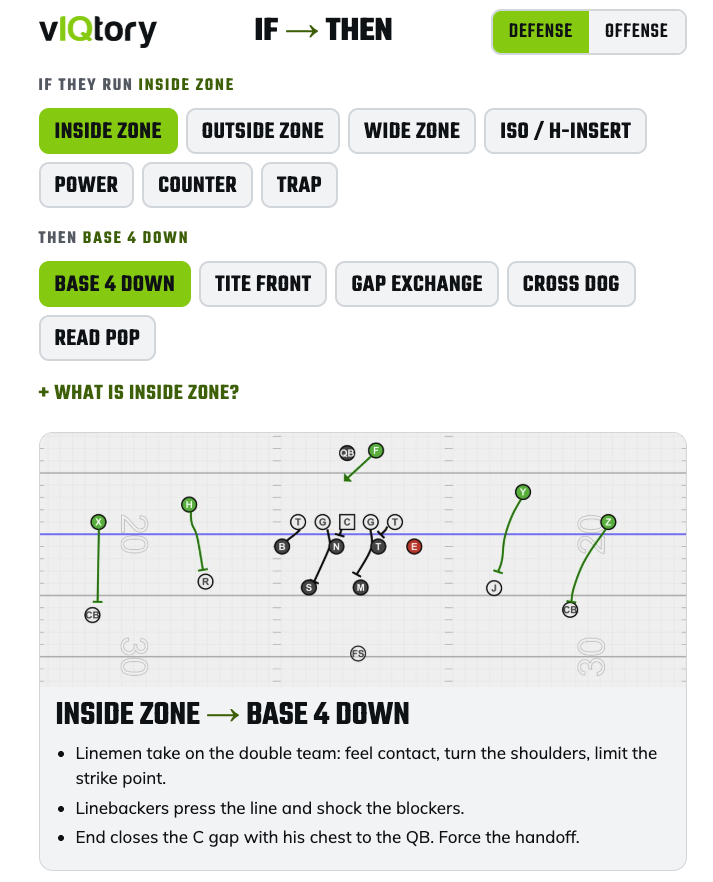
Free Play Calling Guide
Know the exact play to call in every situation
- Pick the front you see. Get the plays that beat it.
- Pick the play they run. Get the stunt that stops it.
- Tap-to-answer tool for the sideline, plus the PDF for your binder.
Maybe your son’s team needed a coach. Maybe the league asked for volunteers. Maybe you love football and thought it would be fun.
Regardless, it’s almost crunch time, and coaching football isn’t like coaching other sports. You have almost twice as many players on the field as in youth basketball, and more moving parts than in youth baseball.
Here’s a list of challenges that you’ll be up against:
- Running practices
- Teaching kids how to play football
- Managing parents
- Creating a playbook
- Making sure the kids are safe
- Winning games (or at least being competitive)
The key is understanding that youth football is very different from watching football on TV or from your playing days.
This guide will walk you through exactly what you need to do as a first-year youth football coach, step by step.
The First Thing New Coaches Get Wrong
The biggest mistake brand new coaches make is trying to coach youth football like high school or college football. They try to coach the kids like they were coached (high-intensity, always yelling at them, demanding respect, etc.).
The major difference between when we were kids and now is that kids have multiple outlets to connect with their friends. If they feel any sense of overwhelm or if it’s not “fun”, they will go back to what is fun: video games.
The goal as a youth coach is to make sure every single kid that you coach comes back the next year.
The wins will come, but the goal is to make sure every kid has the best experience possible. This is how we ensure that youth football stays alive, and your program doesn’t fold.
The other issue is overwhelm. New coaches often try to do too much. They try to install:
- Complicated offenses
- 30 plays in the preseason
- Advanced defenses
- Complex terminology
It may make sense to you and your coaches, but all that matters is that the kids understand it. If not, kids get confused, practices turn chaotic, and the team struggles.
Youth football success comes from simplicity and repetition, not complexity. Your goal as a first-year coach should be simple:
Teach fundamentals, keep your system easy enough for kids to execute, and get them to come back next year.
Problems First-Year Coaches Face
Before we talk about strategy, let’s talk about the real problems new coaches deal with.
Most beginner guides ignore these.
Kids Don’t Listen
This is going to be your biggest pain point. You tell a kid to do something, and he doesn’t do it. This will make you grow frustrated and force you to yell and scream at these players. These players, in turn, will have a bad experience and quit the next year.
Remember, young players have short attention spans. If practices are disorganized, you will quickly lose their attention.
If the kids aren’t constantly listening, you have issues in your practice structure that you need to fix. We’ll cover more of this later.
Remember, patience is everything when working with youth players.
Parents Watching Everything
Parents often stand near the field and watch every rep. This can make new coaches nervous. These parents are often referred to as “helicopter” parents because they watch their children’s every move.
The key to dealing with parents who want to be super involved is to be positive, communicate with them, or even ask them to coach. If they have an issue with something you’re doing, invite them for a conversation.
Hostile parents are often the main reason youth programs sink. Set clear rules with your parents, be over-transparent with them, and remind them that we are all here for the kids. Not egos.
Huge Skill Differences
Some kids have played for years. Others have never worn pads. It’s important that you don’t treat every kid the same. This is why kids quit football. They get matched up in hitting drills with other players who are so much better in skill, and immediately get embarrassed. Coaches may even film it and put it on social media. Please don’t do this.
Identify your 7-10 players who need the most work, pull them aside in a separate group, and spend some time developing them. Even if you need to dedicate one coach on your staff to work with these players individually, be sure to do so. If you treat everyone the same, your best players will get better, and the new players will get significantly worse.
Limited Practice Time
Many youth teams only practice 2–3 times per week. You must use that time efficiently. If you spend 20-30 minutes doing the same drills over and over, the kids are going to get bored, and you will also get bored.
If at any point you feel a drill is getting stale, there’s a good chance your players are thinking the same thing.
Make sure every minute of practice shows coaches exactly what they are supposed to do, and no drill is more than 15 minutes long, and the team period should be no longer than 20 minutes.
Information Overload
New coaches spend hours watching YouTube and going to clinics, but they often get confused about what their team can actually do.
RPOs are great, but teaching a 7-year-old how to read an apex player, find the laces during a mesh point, and deliver a strike downfield on an inside zone glance will make his head spin (Did I just make yours spin as well?). This is why coaching jargon sounds good, but it’s not productive to actually coach kids.
How To Coach Youth Football
Step 1: Start With the Fundamentals
Youth football games are decided by basic fundamentals, not complex schemes. At the youth level, on offense, the key is getting your best player(s) the football in open space. We define open space as a giant hole through the middle or to the outside, where there are fewer players.
The most important skills to teach both your offensive players are:
Stance and Start
Every play begins with proper body position and leverage. A poor stance (3-point stance or 2-point stance) will often lead to poor leverage.
If your team can get into an exposive offensive and defensive stance, then they can generate power to physically move the other team around.
Blocking
Blocking correctly is so important because it allows your best players to run through the line of scrimmage at full speed. Players must learn how to:
- Keep their feet moving
- Maintain leverage
- Engage defenders safely
Hand placement and proper leverage are key when trying to win against the defensive line. Without proper leverage and hand placement, the defensive line will get right by you and make a tackle in the backfield.
Tackling
Safe tackling technique should be taught from day one. Focus on:
- Proper shoulder contact
- Wrapping up
- Driving the feet
Remember, keep the head out of the tackle. We don’t want kids to get hurt. Don’t teach what the NFL or college teams teach with the head in the tackle. It’s dangerous. We want to keep our kids safe and ensure that every player makes it through the season.
Most youth leagues will teach the “Hawk” tackle or some form of shoulder tackling. Teach this technique. Not the “head across” tackling technique we were taught as kids. This one is much safer.
Learn how to organize these skills into your practice plan here.
Step 2: Keep Your Offense Simple
Many first-year coaches install too many plays. Instead, focus on 3–5 core plays that your team can execute well. This way, you can keep the playbook as simple as possible for both your coaching staff and your players.
Examples of simple youth plays include:
- Power
- Sweep
- Counter
- Dive
- Bootleg
Run these plays from one or two formations so players don’t have to memorize too much. Your players should be able to run the same play multiple times in a game with confidence. Remember, execution beats variety and complexity.
We’ll show you how to install an offense from scratch here
Step 3: Choose a Simple Defense
Defensive confusion is a common problem for youth teams. Young players struggle with complicated assignments or being aggressive toward the ball carrier.
Defensive linemen are often too slow coming off the football, and linebackers don’t come forward fast enough. When choosing your defensive scheme, use a single gap system that allows your defense to play fast.
Popular youth defenses include:
- 6-2 defense
- 5-3 defense
- 4-4 defense
These systems are effective because they are easy to teach and strong against the run, which is common in youth football.
We’ll show you how to install a defense from scratch here.
Step 4: Structure Your Practices Properly
Disorganized practices lead to chaos. This will be your biggest headache coaching youth football. However, if you can get your practice structure down and your assistant coaches bought in to what you’re trying to do, it will be a breeze.
The most common inefficiency we see with youth coaching is long, boring practices that are both repetitive and predictable. Kids start fooling around, which then makes you angry. The cycle repeats itself over and over again.
A good youth football practice should be structured like this:
Warm-Up (10 minutes)
Offensive Fundamentals (15 minutes)
Team Offense (20 minutes)
Defensive Fundamentals (15 minutes)
Team Defense (20 minutes)
Competitive or Fun Period (15 minutes)
Review and Breakdown (5 minutes)
How you structure your practices is the difference between kids who want to show up and those who are forced to by their parents. You want to make sure your practice planning is perfect so the kids stay engaged. We show you how to create a youth practice here.
Step 5: Assign Positions
Choosing the right positions for players can make a huge difference.
Consider these general guidelines:
Quarterback
The quarterback is going to be the most reliable player. They are in charge of commanding the huddle, making sure the ball gets handed off or thrown to another player. If this player panics or can’t stay calm under pressure, then you’re going to have consistent turnovers.
Look for players who are disciplined, take coaching, and follow directions. They will be your best players for quarterback.
Running Back
Choose players who are the fastest on your team. The fastest players at the youth level give you an advantage to score points by running to the edge.
Power runners are great for up the middle runs, and speed players are great for outside runs.
Linemen
Players who are bigger, physical, and lack the skills of a running back will be great offensive and defensive linemen. Linemen are typically less athletic (from a speed and quickness perspective), but are great at understanding, leveraging, and generating force through power moves.
Step 6: Manage Parents the Right Way
Parents are a major part of youth sports and may be your biggest supporters or your biggest pain. The best way to handle parent concerns is through clear communication.
Before the season starts, explain what the practice schedule is going to be. Set up a communication process. After games, tell them they must wait 24 hours to contact you about playing time. Everyone is always emotional directly after the game. Those emotions can often lead to bigger problems.
Explain how you’re going to coach, how you’re going to keep their kids safe, and explain that you are going to give their kids the best experience possible. While winning is important, making sure they have a great experience every time they leave practice is your #1 goal.
If parents understand your philosophy early, you will avoid many problems later. If you don’t communicate with them because you don’t like 1 or 2, it will give you headaches all year.
Step 7: Focus on Player Development, Not Just Winning
Winning games is great, but youth football should focus on teaching fundamentals, building confidence, and creating a love for the game. Put yourself in the shoes of each player. If you’re someone who is just screaming and yelling the entire time, what would you do as a kid? You would probably quit because the experience is miserable.
Players who enjoy the experience are more likely to continue playing football. Parents who can see their kid becoming more confident and happy after every practice are more likely to sign them up again.
Your impact as a coach extends far beyond the scoreboard. Remember that!
Step 8: Build a Positive Team Culture
Young players respond to encouragement. Make practices fun while maintaining discipline. Discipline comes from expectations being clear and the players following them.
Remember, if kids are always moving, they aren’t fooling around.
Put them in an environment where they can have fun and are always doing something productive for their development. Celebrate small wins and applaud great effort. Players who feel supported will work harder and improve faster. Constant yelling and screaming will cause kids to tune you out.
The constant yelling and screaming will then burn you out, and you’ll start dreading showing up every day.
Final Advice for First-Year Coaches
If you remember nothing else from this guide, remember these five principles:
- Keep your system simple
- Teach fundamentals every practice
- Use repetition to build confidence
- Communicate clearly with players and parents
- Focus on making the game fun
You don’t need to be a football expert to be a great youth coach. You just need organization, patience, and a commitment to helping kids improve.
Next Step
Now that you know what it takes to be a great youth football coach, let’s move on to the next phase.
Let’s plan your first practice and make sure that all of your coaches are on the same page.