
If you’re coaching youth football for the first time, the moment that causes the most anxiety is your first practice.
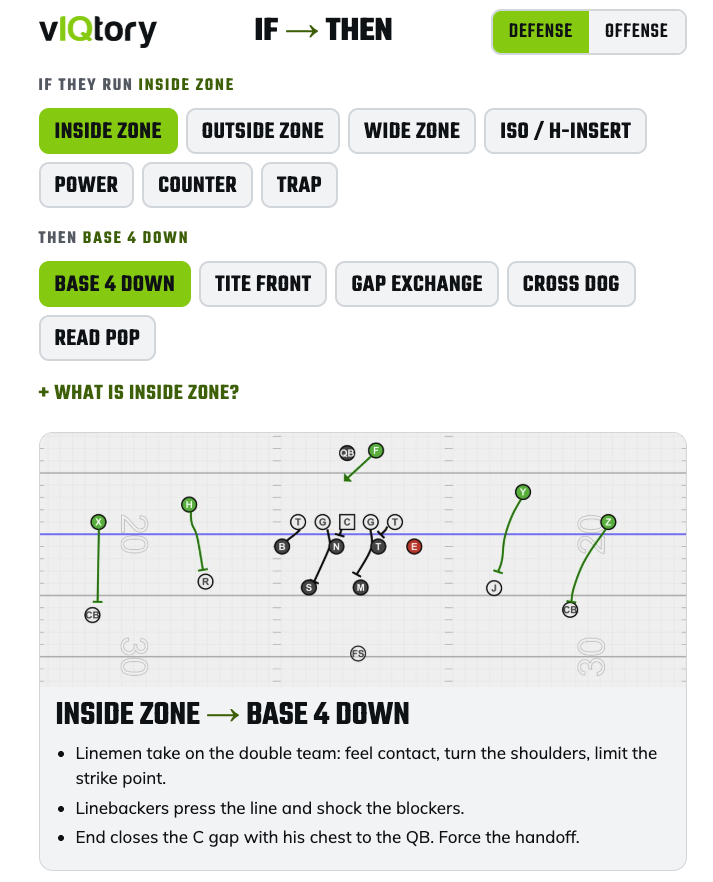
Free Play Calling Guide
Know the exact play to call in every situation
- Pick the front you see. Get the plays that beat it.
- Pick the play they run. Get the stunt that stops it.
- Tap-to-answer tool for the sideline, plus the PDF for your binder.
You’ve got 20+ kids standing in front of you, parents watching from the sidelines, equipment everywhere, and kids who are both excited and distracted
Most first-time coaches make one of two mistakes: They overplan and try to do too much, or they underplan, and practices become chaotic.
The goal of your first practice should NOT be to install an offense or a defense. The goal is much simpler:
Teach the basic fundamentals and establish structure.
Kids should leave the field understanding:
- How practice works
- Basic football movement
- The expectations of the team
Below is a simple first practice plan that works for every youth team. Once the structure is set and all of your coaches feel comfortable, you can move on to installing an offense or defense.
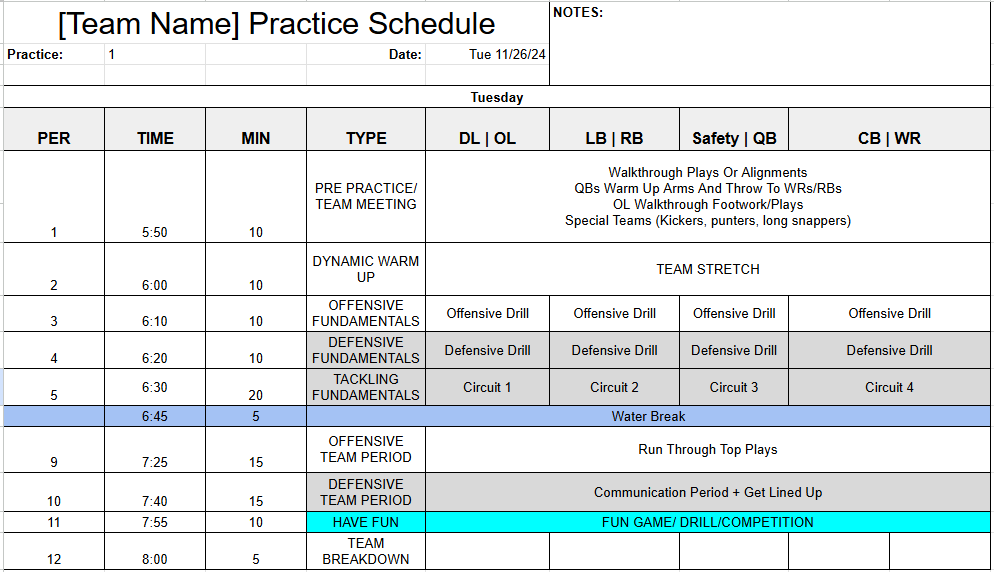
Get Your Free Youth Practice Template
The Perfect First Youth Football Practice (90 Minutes)
Opening Team Meeting (5 Minutes)
Before anything starts, gather the players. Keep it short and simple.
Explain three things:
- Who you are
- What the team values
- How practices will run
Example message:
“ I’m Coach [insert name]. This is our coaching staff (introduce staff). We’re going to work hard, have fun, and get better every day. When I blow the whistle loud and long, it means we are going to rotate to the next period. We are always going to be jogging or sprinting on the football field. We don’t want to walk. We want 90 minutes of hard work, fun, then everyone can go home and enjoy a delicious dinner. Let’s break it down (break it down on “team” or “hard work”).”
It’s important not to lecture. Kids will tune out quickly and will start to fool around. Have them take a knee around you, and keep everything short and sweet. These kids are excited to get going; don’t hold them there for 20 minutes while you anxiously talk.
Dynamic Warm-Up (10 Minutes)
Young players need to move before contact drills. Keep warm-ups active and start to build discipline in your stretching lines
Recommended Dynamic Warm-Up Routine
• High knees
• Butt kicks
• Karaoke
• Side shuffles
• Short sprints
Recommended Static Routine
- Neck Rolls
- Arm Circles
- Butterflies
- Calf Stretch
Close out with jumping jacks and have them break it down on you as a coach. After this moment, everyone is jogging or moving quickly to the next station.
Stance & Start Period (15 Minutes)
This is one of the most important things you teach all season: stance and start. Spend the entire period on making sure that players know how to get into a proper stance. Coach every kid up to make sure they are optimizing as much power as possible.
Every play in football begins with how players line up and explode off the ball. If you want to run the football effectively, you’ll need to train your players to get in a proper 3-point stance.
Getting in an offensive 3-point stance is different than a defensive 3-point stance. Offensively, you need to ensure your players can move in a 360 degrees (to pull, down block, or pass set).
Here’s a video that will help you teach the 3-point stance.
To adjust it for an offensive stance, just bring the back foot closer in and keep their chest up. There should be about 20% of the weight on their front hand.
If you want your defensive linemen to get off the football and play in the opponent’s backfield, it all starts from the 3-point stance.
Drill: Get-Off Drill
Get the players to line up in a straight line (for each position). The coach will say, “Set go!” and the players will explode 5 yards.
When the players get in their stance, have 1-2 coaches critique everyone’s stance so it’s perfect. A quick first step and proper body position are the keys to these drills.
Don’t just say “set go” 25 times to keep kids moving. This is a teaching period. Encourage the kids when they are doing well, and slowly critique when they are not.
Offensive Fundamentals (15 Minutes)
QB + RB Exchange
This is where your quarterbacks and running backs will get together. Young teams often struggle with fumbles and bad handoffs. This is your time to make sure every step and every exchange is perfect.
Spend time early teaching proper ball security and how your running backs take handoffs.
Drill: Get The Ball & Sprint 5 Yards
Have your quarterbacks line up, with a running back directly behind them. On “set go”, the quarterback will hand off to the running back who is running to the right. If you have more running backs than quarterbacks, then add more running backs to the drill.
This teaches players to:
- Protect the ball
- Maintain control under pressure
The key is to make sure every coach is coaching up every minor detail on the exchange.
WR Catching Footballs
If you have wide receivers in your offense, then you’ll need to make sure they practice catching the football.
Drill – WR Break Drill
During this period, you’ll want to get them separated from the running backs and quarterbacks and have them catch football. The best way to practice this is by having your players run:
- 45-degree breaks
- 90-degree breaks
- Vertical throws
Try to do 5 minutes for each break. That way, each kid can see about 5-7 footballs per break. If you have the bandwidth, have two lines, one on the left side and one on the right side, and have 2 coaches throw to those 2 lines.
Offensive Fundamentals – Blocking
While the quarterbacks and running backs are doing handoffs, the offensive line is working on blocking. They are focused on hand placement, head placement, and footwork.
Drill: Fit and Drive
Two players line up face-to-face. One is holding a bag, and the other is blocking it. The bag helps protect the player (who more than likely doesn’t have pads on because it’s the first day).
To run this drill:
- The player fits their hands on the chest of the bag
- Drive feet forward on contact
- Maintain leverage
Keep reps short and controlled. 1-2 steps max. Rotate them so everyone gets efficient reps.
Tackling Fundamentals (20 Minutes)
Tackling should be introduced safely and gradually. Start with technique and end with technique. As a youth coach, you shouldn’t care how hard someone hits. All you care about is that the player makes contact safely and builds their confidence.
Players should:
- Keep their head up and out of the tackle
- Use their shoulder
- Wrap arms around the ball carrier’s legs
- Drive their feet on contact
Avoid full-speed collisions early in practice. Everything done in the first couple of days should be done on bags. Be very adamant about proper technique. Keep every kid safe and make sure they are comfortable hitting bags.
The most effective way to teach tackling is in circuits. If you have 4 coaches, each coach will man a station. This is a great way to practice tackling, because kids aren’t standing in long lines. You can have 5 players to 1 coach, who are working on different tackling skill sets.
Here’s an example of 4 different circuits you could do:
- Tracking/Approach Circuit
- Block Destruction Circuit
- Ball Strip Circuit
- Take To The Ground Circuit
Circuits are great because you can coach multiple skills in a single period.
Offensive Team Period (20 Minutes)
Your team doesn’t need a huge playbook yet. Remember, you want your players to get in the car after practice and be so excited to talk to their parents about the first practice.
The last thing you want is for them to get in the car and be completely overwhelmed. Use simple language and make sure the rules are clear.
The key points to explain are where players line up, who they block, and where the ball is supposed to go. This includes running the play slowly first. Then run it at half speed. The goal is to make sure everyone understands what’s going on. Not to be at full speed. It’s day 1.
If you need to install an offense, we’ve created a base-level guide to get started.
Defensive Team Period (20 Minutes)
During the defensive team period, the number one goal is to make sure everyone can get lined up. That’s it. You’re not installing blitzes, exotic coverages, or anything like that.
1 defensive front, 1 coverage.
Make sure everyone knows two things: their alignment and their assignment.
At the high school level, I even spend 3-4 days just getting lined up. I want every player in our program to know exactly where they are supposed to be at all times.
This is the main goal during this team period. Get everyone aligned to the position they want to play, and have every coach, coach their positions.
If you need to install a defense, we’ve created a full guide here.
Fun Or Competitive Drills (10 Minutes)
Always end the drill on a high note! One of the best things to do to end a youth practice is some sort of fun or competitive drill. Here are some ideas:
- Relay Race – Run back and forth, with each team racing each other.
- Obstacle Course – Set up obstacles like running through bags, or jumping over bags, and have the players race
- Competition – Each team needs to catch 5 footballs from their coach in order to win
- Team Building – Line up all of your players, have them sprint 10 yards (go on 2, go on 3), and make sure nobody jumps offsides. Celebrate as a team when they get it right.
Ending practice in a fun way is a great way for the kids to look forward to the end of practice, while they grind out the beginning and middle of practice.
Team Breakdown (5 Minutes)
Bring the team together and have them take a knee around the head coach. Feel free to invite the parents into your circle. Ask the players questions such as:
- What did we learn today?
- What was fun?
- What can we improve?
End on a positive note.
Example:
“Great work today. Next practice we’ll start building our offense.”
Important note: kids remember the energy you end with. If it’s negative, they will take that negativity with them into the car ride home. If it’s positive, they will feel good leaving practice.
First Practice Mistakes To Avoid
Mistake 1: Too Many Drills
New coaches try to run 20 drills during the first practice. Keep it simple and easy.
Instead, focus on 2-3 important things that your players can take with them to the next day.
Mistake 2: Too Much Talking
Kids learn by doing, not listening. Keep instructions short and clear. Just because you’re talking, doesn’t mean the kids are listening. If you talk for too long, there’s a good chance they have phased out. Keep them moving with short coaching breaks that last 30 seconds max.
Mistake 3: Standing In Lines
Players standing in lines get bored, or even worse, they fool around. Design drills with multiple reps happening at once.
Keep the lines 3 players deep at maximum. If you have lines that are 10-15 players long. They will start to talk and fool around with their friends, rather than pay attention to you.
Mistake 4: Installing Too Much
Your first practice should focus on:
- Movement
- Fundamentals
- Organization
The playbook can wait until days 3 and 4. If you establish sloppy fundamentals, then you are building a house on a weak foundation. Once the fundamentals are established, you can build from there.
Get Your Free Youth Practice Template
What’s Next?
Now that you have the structure of your first practice, let’s move on to installing our offense or defense. Select below.