If you just volunteered to coach youth football, one of the first questions you’re going to ask is “What offense should we run?” It’s one of the hardest things to determine as a coach.
Free Play Calling Guide
Know the exact play to call in every situation
- Pick the front you see. Get the plays that beat it.
- Pick the play they run. Get the stunt that stops it.
- Tap-to-answer tool for the sideline, plus the PDF for your binder.
If you’ve been searching online, there’s a good chance you’re drowning in complex football terminology like:
- Wing-T
- Double Wing
- Air Raid
- Power I
- Zone read
And before you know it, you’re watching college film cutups and reading coaching clinic notes, thinking “I have no idea what any of this means.”
Let’s simplify things. If you are a first-year youth football coach, your offense does not need to be fancy. In fact, the simpler it is, the better. The key is to make sure your players know who to block, and your running backs know where to run. The team that often wins is the team that makes the fewest mistakes.
So in this guide, I’m going to show you a simple youth football offense that works almost anywhere, even if you’ve never coached before.
Naming Your Offensive Players
This is the first step in building an offense. That way, when you want to coach your players up, they understand what positions they play. If you just label them “RB” and “WR”, they won’t know where to line up.
There are a few ways you can name your players
Numbers
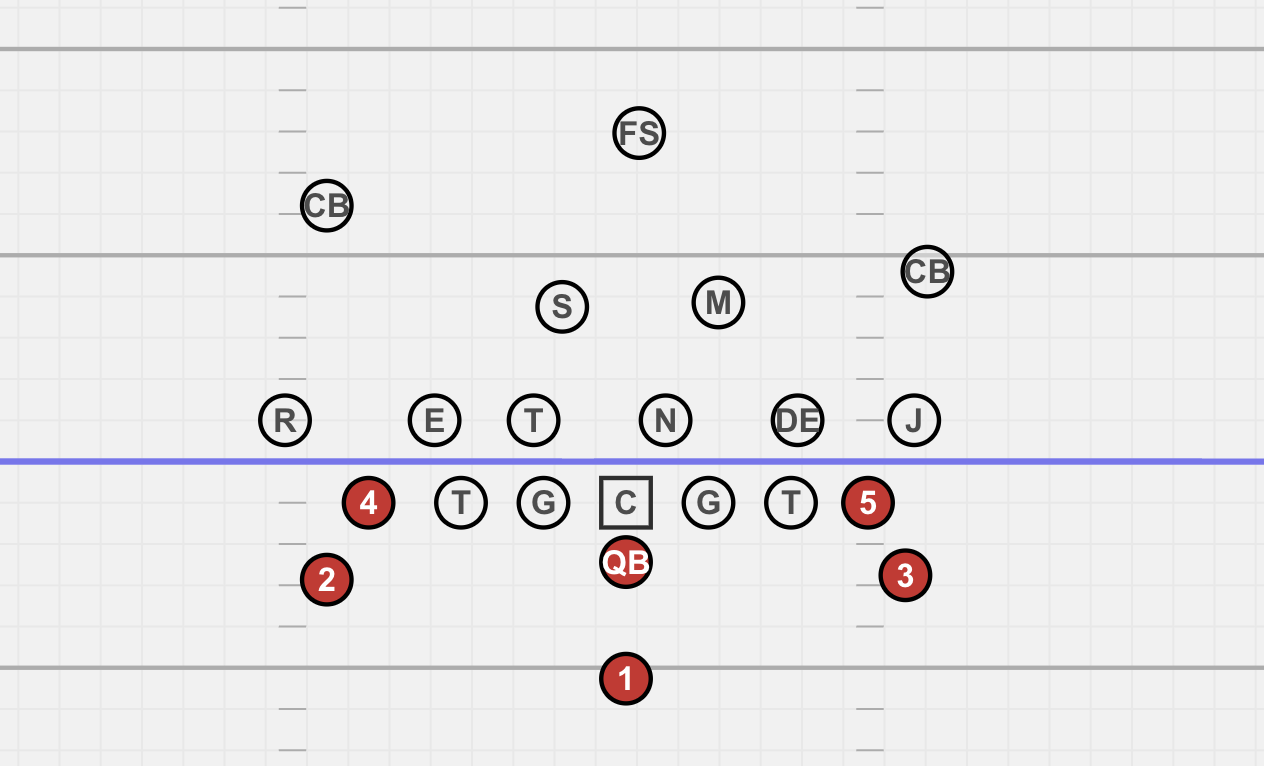
This is the easiest way to direct players where to line up. Starting with #1, this player will be your fullback or the player who lines up directly behind the running back.
The #2 and #3 are your wings, which can line up anywhere on the left or right side.
#4 and #5 are your tight ends or your wide receivers. This way, you can keep #2 and #4 on the left and #3 and #5 on the right.
Letters
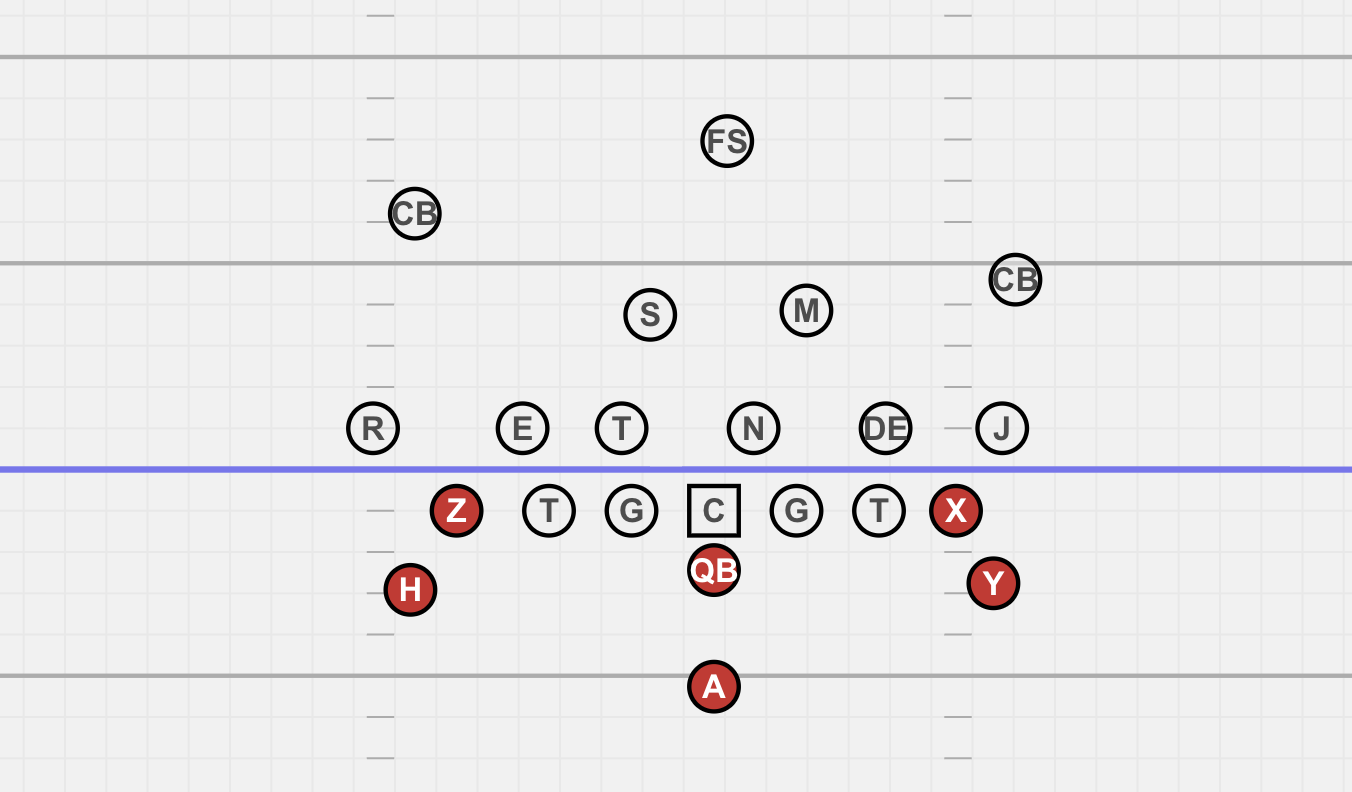
Another common way to name your players is through letters. You can use the A, B, C, D, E system.
Or if you want to step into more of a professional lettering system, you can use A, H, Y, X, and Z. The H and Y are the wings, and the Z and X are the wide receivers/tight ends.
In the end, it doesn’t necessarily matter what you name them, as long as your coaches and players know how to identify them.
Formations
Next is to build formations. For our example in this blog, we are going to work in the double-wing offense. This offense is great for running the football and using play action against your opponents.
For the formation name, we’re going to call it Falcon (using “wings” as the relation to falcon) because we’ll have two wings off the tight end (labeled as 2 and 3). Every formation we name, we want to relate it back to something so the kids can cross-reference it.
In Falcon, our offensive linemen will line up 3 inches apart. There should be barely any space between their feet, and they should be almost touching.
The running backs will be in two-point stances on the wings and a 3-point stance at fullback.
The wide receivers will be lined up as tight ends of this play, in a 3-point stance.
Run Plays
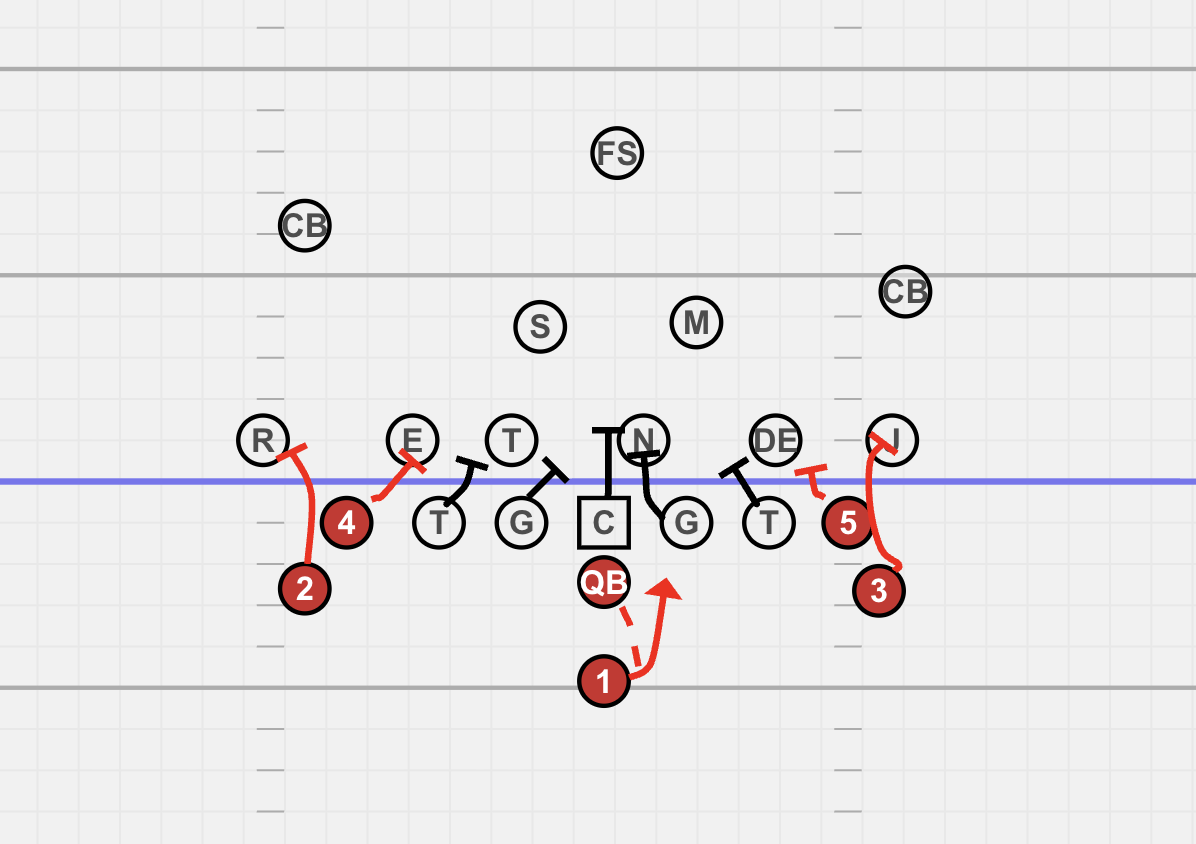
Now that we have our first formation Falcon, let’s insert our first play. Our first play will be a simple fullback wedge play.
So the play call will be: Falcon Wedge Right
Falcon = Formation
Wedge = A blocking scheme for everyone to step to their inside
Right = Play direction for the quarterback and 1 back
Blocking Scheme
Every run play needs to have rules. Not just “block the person in front of you”. The reason you want rules is that things change in football. One week you may see a 4-4 defense, the next you may see a 5-2. Players should know, by their rules (not by you telling them every play), who they should block.
For our wedge blocking, all 5 offensive linemen and the tight end will follow the same rules. Everyone is going to take 1 step toward the inside with their inside foot. The key to wedge blocking is to get everyone moving in one direction as a single force to overpower the defensive line.
Once they take their first inside step, keep driving forward to displace the defensive linemen.
Running Back Rules
The fullback (FB) will take the handoff and try to run as hard and as fast as he can behind the guard and center. The key is to go forward, and not laterally. If you gain 4 yards, it’s ok. 2 more 4-yard gains and we have a first down!
The wings, both right (RW) and left (LW), will also take a step to their inside. Again, trying to join the mass of bodies.
Quarterback Footwork
The quarterback will open up toward the FB and give him the ball. The most important part of the play is the handoff to the fullback, and to ensure he doesn’t fumble.
Once the quarterback hands the football off, he needs to get out of the way.
Pass Plays
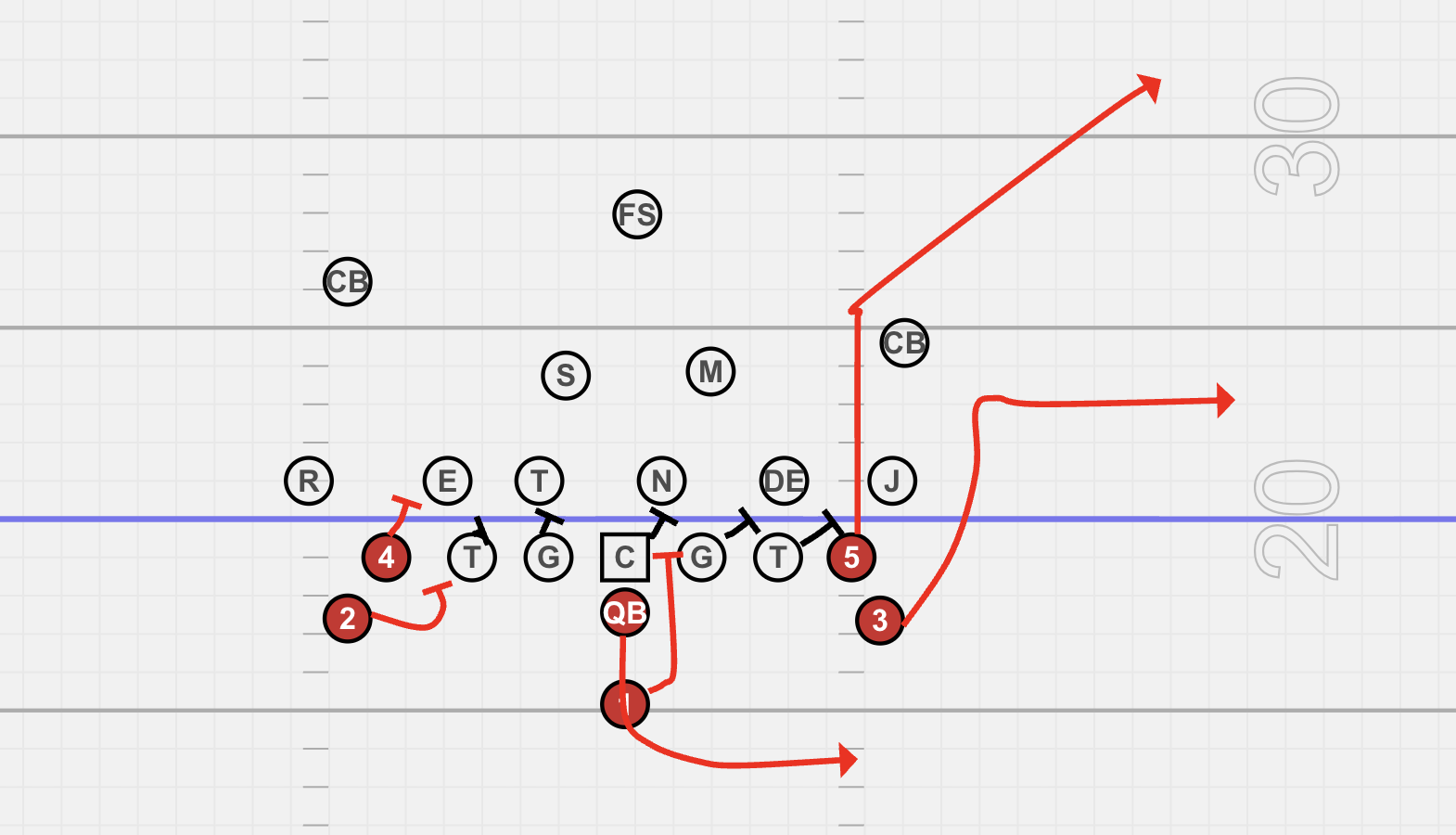
Now that you have your base run play in, it’s important to build a play-action pass play off of it. The play action pass play is making the defense believe you are running it, but at the last second, you pull the football out of the belly of the fullback and throw it.
That’s exactly what we’re going to do with our first pass play.
This play call will be: Falcon Flood Right.
Falcon = Formation
Flood = Pass Concept
Right = Which way the offensive line is blocking, the pass concept is going and the fullback is going to fake
Pass Blocking Rules
Every offensive lineman is going to protect their gap to the right side. This is because we are going to roll our quarterback to the right side. So, before the ball is even snapped, each player should point to the player in their right-side gap.
WR Routes
The flood concept is simple. We’re going to run a corner route with the tight end at 7 yards, and an out route with the right wing (RW) at 3 yards. We’re hoping the defense will keep their eyes in the backfield, go after the fullback, and not cover the two receivers running routes.
Play Action Fake
The quarterback is going to fake to the fullback, who will try to act like he has the ball. The better his fake, the more wide open your receivers will be. The lazier the fake, the more covered they will be. Everything should look like you’re running the football.
Once your quarterback makes the fake, he should roll to the right side to throw to his receivers. If he’s a lefty, then call the play to the left side.
Congratulations, you just installed your first run and pass play!
What’s Next?
Now that you know the basics of installing plays, you can get creative in who gets the football. Keeping the same naming structure, you can add plays to your playbook that your players can easily understand.