How To Coach Wide Receivers: Technique, Catching & Blocking
Wide receivers must possess multiple skills in order to be effective. They must be able to block, catch the football, and stretch the field vertically. Every skill the wide receiver needs can be taught and be improved over time. Work on each skill weekly to build a wide receiver core that stresses defenses.
Below you'll find all the resources you need to coach any wide receiver in any system. We'll show you proper stance and start, catching mechanics, blocking, and ball security.
If you're looking for more in-depth video resources, see the full wide receiver install inside of vIQtory Pro.
Core Wide Receiver Skills
Below, we're going to cover 4 wide receiver skills that you teach, in order. It doesn't matter if you're a youth or a high school coach; these skills are applicable to all receivers that line up in the slot or out wide.
Stance & Start
This is, in my opinion, the most undercoached technique at the wide receiver position. Wide receivers are the worst offenders at looking at "cool" things online and trying to mimic them. They try to copy NFL receivers who have elite talent and can get away with poor mechanics.
Wide receivers should try to get in the most comfortable stance possible, optimizing for one thing: speed.
Speed and positioning are what allow receivers to get open. Getting in a stance that has 70% of the weight on the front foot, ready to fire off the line of scrimmage, will allow your receivers to close space on the defensive back fast.
Catching Mechanics
Not all throws are created equal. As a wide receiver coach, it's your job to make sure that your wide receivers see as many catches as possible, from all different angles. Most coaches will only do catches that are straight at the receiver (like catching a hitch) or over the shoulder (like catching a deep fade).
However, there are bad ball catches, low ball catches, and high ball catches. All of these catches are significantly harder when a defensive back is contesting it.
Here's a list of catches to add to your ball drills:
- Over the shoulder
- Running Left/Right
- Bad Ball (Behind on a fade)
- Low Ball
- High Ball
- Diving
Practice these catches with proper hand placement and a 5-yard burst after the catch to get used to tucking the football away.
Stalk Blocking
If your team runs jet sweeps or perimeter runs, it's important that your edges are secure with a proper stalk block. Wide receivers should learn how to get their hands fit up on the defensive back properly, but with their elbows in and their thumbs up.
Next, their body positioning is all based on if they are getting a run to them or a run away from them.
Play to them - Leverage the block away from where the ball is going. If it's a run to the inside, push the cornerback out. If it's a run to the outside, push the cornerback in.
Play away from them - If the play is running away from the wide receiver, it's important that they cut the angle off of the backside corner. This way, he can't make a touchdown-saving tackle.
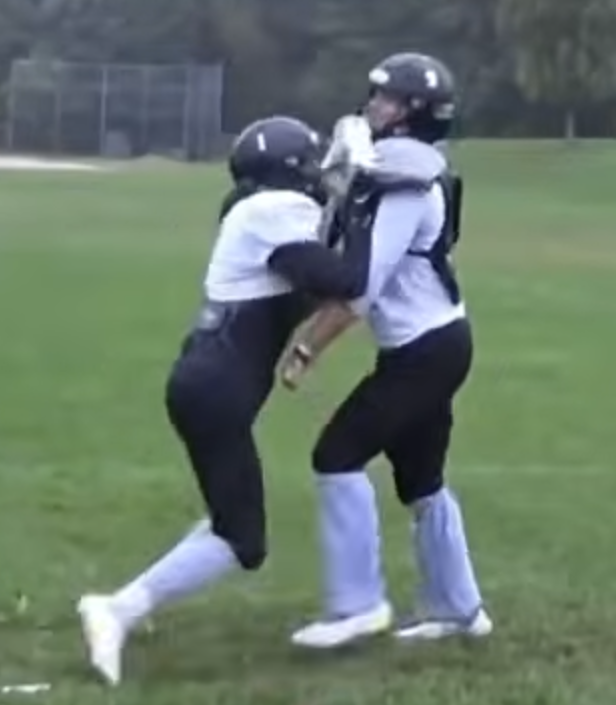
Next, it's important the feet are wide on contact. If they are too close together, they will get thrown to the ground. We want a wide sturdy base, so the defender can't throw us left or right. We practice this by doing this "Chaos" drill.
Watch Here On X: https://twitter.com/i/status/1635976890027757568
Find more stalk-blocking drills here.
Route Running
Slow receivers can get open too. Not every receiver needs to be lightning fast. Route running is all about leverage and breaks. If your receivers know how to take advantage of inside and outside leverage, win the stem, and finish with the stack, they can win most vertical routes.
If you already have fast receivers, the next step is just teaching them how to be technical and to manipulate the defensive back's hips. We show you exactly to get open and run routes here.
Wide Receiver Coaching Progression
Below is how we coach our wide receivers from day 1 all the way to the end of the season. We've also included player progressions so you can see if what you're teaching is working.
Steps To Install | Coaching Points | Availability |
|---|---|---|
Step 1: Stance & Start | Have the wide receiver put 70% of their mental weight on that front foot. Sprint hard within the first 5 yards every play. | Wide receivers should be seen sprinting off the football every single play. The defense should not know if it's a run or a pass based on how hard and fast the WRs come off the ball. |
Step 2: Stalk Blocking | Approach the defensive player with a wide base. Attach to the shoulder pads with thumbs up and chin below their chin to win leverage. | Edges are secure, and any outside run that you have is able to get down the sideline without the corner's interference. |
Step 3: Ball Catching | Coach your players to catch the football from all angles. They should know when to turn their hands or use the basket-catch technique. | Players should be able to run and catch every ball thrown at them. They adjust at the last second and show late hands so the defensive back can't play through them. |
Step 4: Route Running | Take advantage of the pre-snap and post-snap leverage from the defensive back. Learn how to stem, stack, and twist up the defensive back. | Receivers know exactly how to win leverage just by running routes. Simple routes are no longer just running straight; they involve adding cuts and head fakes at the top of the route. |
Common Wide Receiver Coaching Mistakes
Not Practicing Live Stalk Blocking
Stalk blocking drills are great for players to understand technique. However, players should go live at least once a week so they can understand the speed and physicality the position demands. You don't want your receivers seeing a live rep for the first time during the game.
Not Catching At All Angles
Receivers should catch every type of ball, not just the easy ones to catch. As mentioned above, catching different angles at different speeds is what helps to improve receivers' catching ability,
Not Addressing Lazy Play
Wide receivers get a bad reputation for being lazy. If your receivers are walking off the football or aren't sprinting, it needs to be addressed. We have a rule where, on every play, the receiver needs to sprint 5 yards off the football. This forces them to stress the defensive back, whether it's a run or pass.
Get More Drills & Video Instruction Inside vIQtory Pro
The Full Wide Receiver Install: Get drills and video instruction on how to coach wide receivers. Inside you'll find a library of drills, progression on how to coach your position and game plan tools to put it all together on game day. Built for youth and high school coaches.
Coaching Resources
©2026, vIQtory Sports . All rights reserved
Follow Us