
Running routes is an art. There are great route runners that come in every speed and size. The key to running great routes is understanding leverage and how to best position yourself to catch the ball.
Free Play Calling Guide
Know the exact play to call in every situation
- Pick the front you see. Get the plays that beat it.
- Pick the play they run. Get the stunt that stops it.
- Tap-to-answer tool for the sideline, plus the PDF for your binder.
In this article, we’re going to show you how to run routes and everything you need to know to always get open.
This is one piece of the wide receiver install. The full progression is in the guide on how to coach wide receivers.
Route Running
Running routes all begin with a loaded up stance and start. Without a good stance and start, the speed and pressure you put on the defensive back will decrease.
Once your receivers have gotten off the line of scrimmage, teach their bodies how to get in and out of cuts. Most coaches will overcoach this part. Ideally, you want your receivers to get out of their break in 3 steps; however, if they get out in 5, it’s ok. Everybody is different, and every hip control is different for each player.
Getting In And Out Of Breaks
The rule of thumb for getting out of breaks is that anything under 5 yards, your receiver should be able to get out of it in 1 cut. This means they should be able to pressure cut off their inside or outside foot to get to their desired location.
Anything over 5 yards is when they will need to drop their shoulders and get out in 3 steps. The reason is that the more speed you accumulate, the more the breaks need to work harder (think of it going from 60mph down to 0mph, vs going 20 mph down to 0mph).
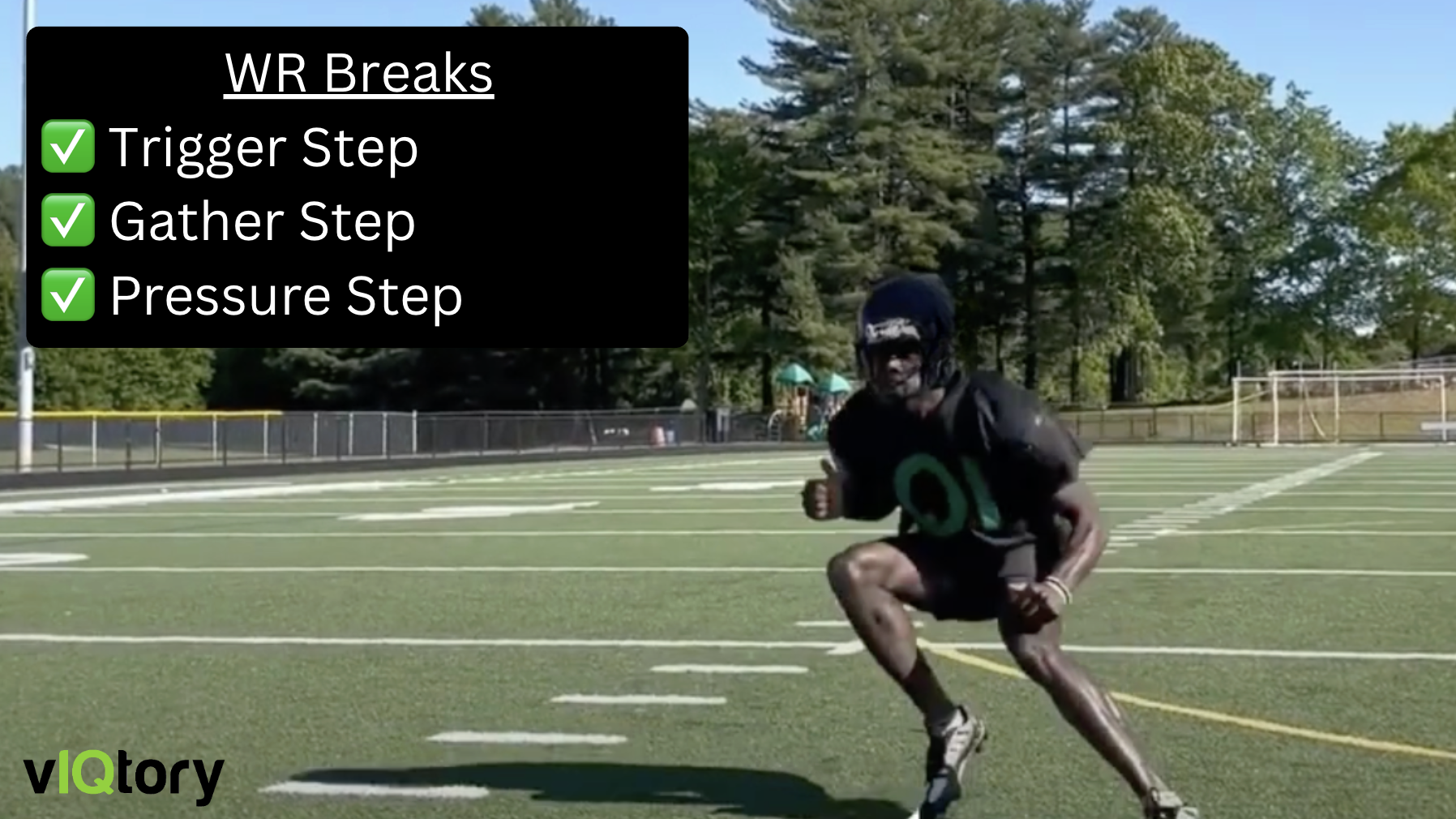
If your receiver is going to get out of a break in 3 steps, it’s important that your receivers understand the footwork and the cadence. These are the 3 steps:
- Trigger Step – The trigger step is when your body starts to decelerate. This step starts the breakdown. This step should be violent. Hips should start to sink, and the chest should start to come down on the trigger step.
- Gather Step – The next step is to gather and collect their weight. Because so much weight is moving forward, the body needs to recalibrate and shift the once-forward-moving weight backward.
- Pressure Step – The last step is the pressure step, which requires the receiver to push off their inside or outside foot, in the opposite direction they are going (push off left to go right).
If the receiver is running something past 12-15 yards, he may get out in 5 steps, and that’s ok. If the player doesn’t have the hip strength or the core strength to control his body, this may occur.
Coaching The Break Points
While we have names for all of these steps, it’s best to let the body figure it out on its own. If you try to coach every little detail, the player will be thinking instead of running. They will telegraph when they are breaking because they are counting steps, not selling their route vertically.
The main coaching point is to try to bring their chest to their knees and drop their arms to the outside of their knees. If they can violently drop to this point, everything else will take care of itself.
As your receivers run routes, see if they can comfortably get to this point of chest down and arms bent.
Once they are able to, then you want to teach them to run out of their cuts. Remember, speed in and speed out is the game. If they do a great job of getting out of their cuts, but are stuck in the mud, the defensive back is going to close space.
Speed in and speed out should always be on their mind.
Free Play Calling Guide
Know the exact play to call in every situation
- Pick the front you see. Get the plays that beat it.
- Pick the play they run. Get the stunt that stops it.
- Tap-to-answer tool for the sideline, plus the PDF for your binder.
To learn more about wide receiver techniques, read these articles next: