How To Coach The Offensive Line: Footwork, Run Blocking & Pass Blocking Fundamentals
The offensive line is the foundation to any great offense. Poor footwork and fundamentals will put the running back and quarterback under pressure. If you coach your offensive linemen to understand leverage and force, you will be able to drive defenders off the line of scrimmage and open up huge holes for your running back.
This guide is a progression on how to best coach your offensive line (center, guards and tackles) to create a unit that works together to accomplish the same goal. No statistics are given to the offensive line. But they are the most important group on the football field.
If you want to expand your offensive line coaching skills even more, get access to vIQtory Pro below, where you can find offensive line drills, practice plans, and step-by-step instructions to build a dominant offensive line.
Core Offensive Line Skills
Below, we're going to teach 5 main skills that every offensive linemen should know. The more the offensive line knows, the more interchangeable they are. As an offensive line coach, you never want to be in a position where 1 player only plays 1 position. This severely limits your depth and ability to move players around if any injury occurs. Teach each player these fundamental skills and you'll be able to increase your depth chart.
Stance
Out of all of the positions in football, the stance for an offensive lineman is the most important. False steps are the #1 killer for poor offensive line play. In order to generate effective power as an offensive linemen, force must be put through the ground going forward. False steps or poor weight distribution cause offensive linemen to stand straight up or step too wide so they don't generate any power.
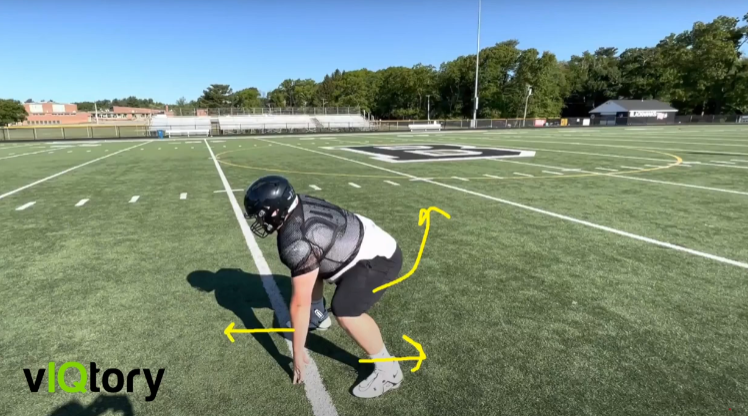
In order to get into a proper offensive line:
- Feet should be shoulder-width apart, with the hand-down foot being back slightly. Ideally, if it's an offensive lineman on the left side, their left foot should be back.
- Next, squat down so the chest is up and the hips are loaded back
- Last, if you're in a run-dominant offense, put 40% weight on the front hand to be able to fire forward. If you're in a 50/50 run/pass offense, put 20% weight on that hand so you can get into your pass set.
If you want to learn more about the offensive line stance, read this article here.
Start
Because the offensive line needs to work in 360 degrees (run blocking at different angles and pass setting backwards, the first step is most important. This means when the ball is snapped, how they are distributing their weight matters to properly own leverage.
We use the word "leverage" a lot because it's what wins or loses a rep. If you give up too much leverage one way, the defense wins. So if the first step overcommits, the defense can win to the inside. If the first step isn't big enough, the defense can win to the outside.
Offensive linemen should load their "mental weight" onto the foot they need to push off of. For example, if your player is pulling to the right, they should load their mental weight on the left foot. This will help them push off of it, avoid false steps, and be able to generate the proper depth and leverage to block the defensive end.
If you're having issues with your offensive line moving defenders off the football, I can almost guarantee it's because of their stance and start.
Run Blocking
Run blocking is the most important skill an offensive linemen can have. Controlling the line of scrimmage and the clock by running the football is the biggest weapon an offensive coordinator can have. Failing to run the football forces coaches to throw the ball 30-40 times a game, which is not ideal (for most offenses).
Offensive line run blocking schemes include different blocking types. These types are often associated with the type of play that's being run. For example:
- Down Blocks
- Pull Blocks
- Double Team Blocks
- Hinge Blocks
- Zone Blocks
These main run blocks are the core blocks that offensive linemen have to make. Some offenses may require only 1-2 blocks; some may require more. Regardless, it's important to focus on the first step, head placement, and hand placement of each of these blocks, as that determines the success of each block.
Pass Blocking
Pass blocking requires the proper set depth, footwork and hand placement in order to be succcessful. Defensive linemen are getting more and more creative with how they attack offensive linemen in the pass game. From spin moves, or club rip or club arm-over moves, there are endless varieites of pressures from the defense.
When pass blocking, there are different types of sets that your offensive linemen can take. Here are the most popular ones:
- Short Set
- 45 Degree Set
- Vertical Set
A short set, also known as a pop or a jump set, is when the offensive linemen immediately set on a defensive lineman. This means they will be more aggressive toward them laterally, rather than kicking backward. This set is ideal off offensive guards, as it helps to form the structure of the pocket.
The 45-degree set is when the offensive tackles set at 45 degrees out toward the defensive end. The set forces the defensive linemen to run a wide edge, as the offensive tackle's body position naturally pushes them out. Be careful not to overset as the defensive end coming back up underneath is a way to beat this set.
Last is the vertical set. This is when the offensive linemen kick backward, instead of out. This helps to form the structure of the pocket and allows offensive tackles to ride the defensive end up the field. This is great for quarterbacks who feel comfortable in the pocket, as the edge defenders will be pushed up the field, allowing them to step up and deliver the football.
Double Team Blocking
When moving defenders in a zone scheme, proper double team mechanics are important. There are two types of double teams: zone and gap.
On a zone double team, the two offensive linemen are trying to move the defensive tackles vertically and deliver them into the linebacker's lap.
On a gap double team, the offensive linemen are trying to move the defensive linemen at a 45-degree angle or carry them into the backside linebacker's lap. Regardless, the movement back into the linebacker is what we're trying to accomplish as offensive line coaches.
Step By Step Coaching Progression
Below is the tested order we install each of our offensive line skills, so you can be sure that your offensive line is prepped and ready for game day.
Steps To Install | Coaching Points | Player Progression |
|---|---|---|
Step 1: Stance & Start | Spend the most time on this phase as it's often overlooked. Make sure every player is optimized for power. | Players should be able to comfortably be in their 3 or 2 point stance for 10 seconds or more. No false steps and they should drive defenders downfield. |
Step 2: Run Blocking | Focus on proper head and hand placement. Missed blocks are often because of 1 of these 2. | Player should generate force from their stance to be able to move defensive linemen backwards off the line of scrimmage. |
Step 3: Pass Blocking | Teach your players how to set and punch through the defensive linemen's chest plate. | Players should block with a "stone wall" mentality, meaning they aren't going to give up ground and will build a clean pocket for the quarterback to throw from comfortably. |
Step 4: Specialty Blocks | Pull blocks and double team blocks are the types of specialty blocks that will help your team with gap scheme and zone scheme runs. | Players should be comfortable with how to position their hands and head to effectively move the defenders. |
Common Mistakes Offensive Line Coaches Make
Not Focusing On Footwork
Offensive line coaches will often focus on their scheme and less on the fundamentals and techniques of an offensive lineman. The most important part of coaching the offensive line is to make sure they can get into an optimized stance and are firing off at full speed.
Not Coaching Head Placement
Run blocks, such as gap blocks, are often lost because of head and hand placement. Too far in front will allow the defensive linemen to cross over to the play side. Not far enough in front, and the defensive linemen can penetrate the line of scrimmage. Head and hands are key after the initial stance & start
Not Rewarding Your Players
There are no stats with the offensive line. Create a reward system for pancake blocks, or blocks that went the extra mile, to keep your players motivated. It's a hard job and a long season being in the trenches as an offensive lineman. Let the players know you appreciate their hard work and efforts.
Going Live Right Away
Knowing who to block is just as important as knowing how to block. We recommend you use individual periods showing players how to block and then using slowed-down group periods teaching them who to block. This way, there is no hesitation on who to block when it comes to game time.
Get More Drills & Video Instruction Inside vIQtory Pro
The Full Offensive Line Install: Get drills and video instruction on how to coach the offensive line. Inside you'll find a library of drills, progression on how to coach your position and game plan tools to put it all together on game day. Built for youth and high school coaches.
Coaching Resources
©2026, vIQtory Sports . All rights reserved
Follow Us