
The quarterback position is one of the unique positions in all sports. They start the play on offense, command the game, and often distinguish between the teams winning and losing.
Free Play Calling Guide
Know the exact play to call in every situation
- Pick the front you see. Get the plays that beat it.
- Pick the play they run. Get the stunt that stops it.
- Tap-to-answer tool for the sideline, plus the PDF for your binder.
However, not everyone can play quarterback. The position is challenging at the youth, high school, college, and professional levels.
This article will show you everything you need to know about playing the quarterback position.
This is one piece of the quarterback install. The full progression is in the guide on how to coach quarterbacks.
How To Train A Quarterback
If you want to train a quarterback, there are many steps that you need to take. Understand that developing a good quarterback takes time, and it doesn’t happen overnight.
Teaching Them The Playbook
As we previously mentioned, all quarterbacks must know the playbook in and out. We can’t stress this enough because the quarterback’s wrong step or turn can mess the entire play up.
Quarterbacks should know what they’re doing each play, as well as their linemen, running backs, and wide receivers. If anyone has any questions in the field, the quarterback can answer them. At a bare minimum, at least know what the running backs’ and wide receivers’ responsibilities are.
Remember, a quarterback is essentially like having another coach on the field. If a player doesn’t know what they’re doing, you can’t run the play and hope for the best.
Helping each player understand their duty is a large part of playing quarterback.
Learn How To Take A Snap From The Center
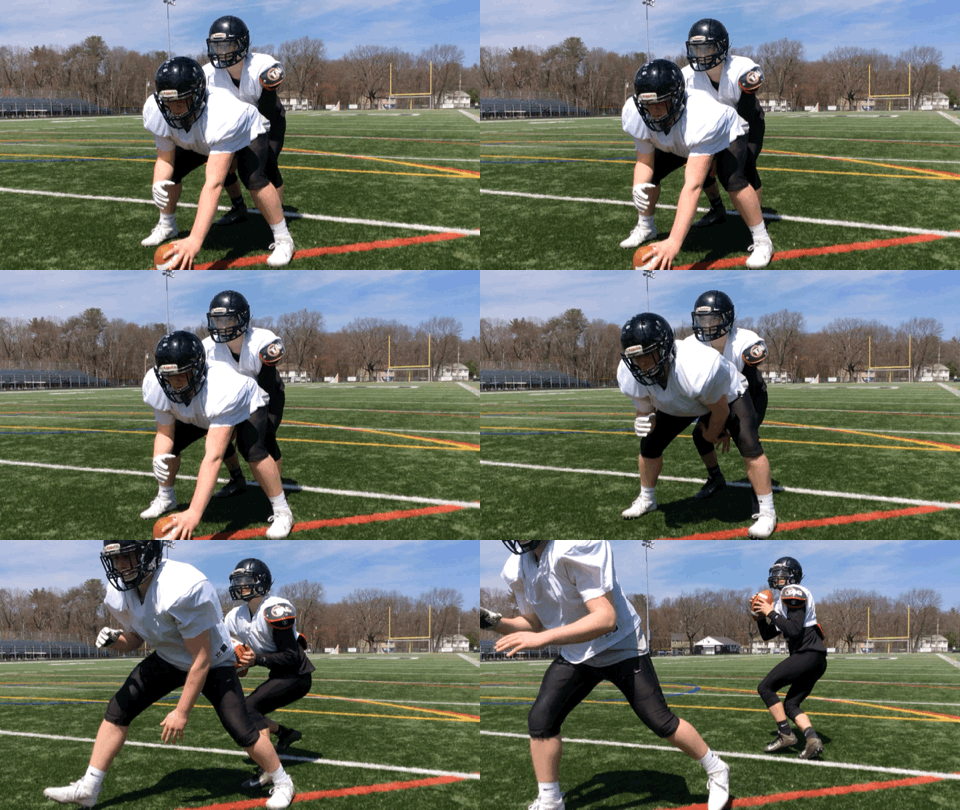
After learning the playbook, the next step is taking a snap from the center. This is how a play starts, and the last thing you want is to mishandle a snap and constantly have the ball on the ground.
If you take a snap from the center, there are a few key points.
First, the back of your palms should touch with your hand wide open. It’s essential to make sure your hands are tight together; the ball doesn’t go through when the center snaps the football.
Learn the cadence from your coach. Make sure that you yell out the cadence loud and clear when you yell out the cadence. Imagine thousands of people in the stands, and the wide receivers standing 20 yards away from you need to hear it.
Once the ball is snapped, firmly grasp your hands around the ball, and continue to start the play.
If you’re a quarterback taking a snap from shotgun (from a distance), focus on catching the ball from the center. We recommend taking 100+ snaps a day from the center. That way, you can properly catch the ball and start the play.
Commanding The Huddle
Good quarterbacks can command any huddle that they’re in. What does that mean?
Commanding a huddle means that the other players are attentive when you’re speaking. They are not distracted by anything other than the quarterback talking.
The ability to command a huddle plays a significant role in earning other players’ trust.
The best way to command a huddle as a coach is to put in place rules for your other players that nobody talks besides the quarterback. Make sure the huddle is a tight formation, and that all the players exit with a “break” in unity.
Get Your Free Practice Template
Choose your high school or youth practice template below to start running more organized practices.
Quarterback Mechanics
Below are the basic footwork and throwing mechanics that you can use to get your quarterback started. If you want more in-depth throwing mechanics, read the article here.
How To Take a Drop As A Quarterback
Once the quarterback receives the ball, and it’s a run play, they will hand it off.
If it’s a pass play, the quarterback must get away from the line of scrimmage where the other lineman is.
The separation steps from the offensive lineman are known as a “drop.”
Football coaches will have different drops for the quarterback depending on the offensive system.
The most common drops are 3, 5, and 7-step drops. These drops are often timed up to the routes that are being run.
Three-step drops are often for quick, under-center throws. Five-step drops are for intermediate, downfield throws. Seven-step drops are for deeper throws, which require time to develop and allow the receiver to get to a landmark.
We recommend practicing all 3 of the drops so you can execute them when the coach asks.
How To Throw The Football
Whether you’re a youth, high school, college, or NFL quarterback, the mechanics of throwing a football are relatively the same. The only thing that changes is the size of the football.
Throwing a football requires flawless mechanics. It’s not about being big or strong. The quarterback must generate power from his lower body to throw the football accurately and farther downfield. Let’s learn more.
First, position your legs slightly wider than shoulder-width apart. Unlike sports like baseball, there is no mound to push off of. The quarterback must generate power from a flat surface.
The weight should be evenly distributed between the two feet, with the player comfortably standing on the ball of each foot.
Next, the ball should be higher than chest level. You don’t want the football to be above the shoulder because you will lose power when you throw. We’ll explain more in just a second.
Take a 6-inch step toward the target when you’re ready to throw. That is all you’ll need to generate enough power from your hips. If the stride is too big, you will lose power, and your throw will often sail high.
As your hands break apart, you want your elbow to come back and make the letter “L,” or 90 degrees.
Start to bring your arm forward, led by the elbow. This will cause a “whip” motion with the arm. This whip motion is what causes the football to generate power.
Aim toward your target and throw the football to them. It’s essential to make sure your hand rolls over the football. Your index finger should be the last finger that leaves the football.
It should rotate externally and finish across your body in your opposite pocket.
Repeat this process several times until you successfully throw the football with a spiral and with less effort.
How To Be A More Accurate Quarterback
Once you’ve got the mechanics of how to throw a football down, you need to perfect your throwing motion.
To become a more accurate quarterback, we recommend starting with stationary targets. Use nets, trash cans, or any target that you may have around your house.
Get a feel for the football, and understand how much power you need to throw it a certain length.
Once you start throwing to a stationary target, we recommend moving targets.
Being a more accurate quarterback relies on rhythmic timing to your receivers. Consistently meet with your receivers and throw different routes to them.
This will help you understand their timing and breakpoints, so you can deliver the football to them as they break away from the defender.
Attitude Of a Quarterback
To be a good quarterback, the quarterback must have a positive attitude with a short memory.
A positive attitude encourages other players to keep moving on, even when bad things happen. Football is a chaotic sport. Football players must remain calm and collected amid all the chaos.
Quarterbacks, in particular, shouldn’t panic when things don’t go their way.
If the quarterback throws an interception, the quarterback should have a short memory. Dwelling on bad plays will only make things worse. It’s important to forget about the bad plays and move forward with the plays that are about to happen.
Free Play Calling Guide
Know the exact play to call in every situation
- Pick the front you see. Get the plays that beat it.
- Pick the play they run. Get the stunt that stops it.
- Tap-to-answer tool for the sideline, plus the PDF for your binder.
To learn more quarterback techniques, continue reading here: