
The difference between a quarterback who can push the ball 20 yards downfield vs 40 yards downfield can completely change an offense.
Free Play Calling Guide
Know the exact play to call in every situation
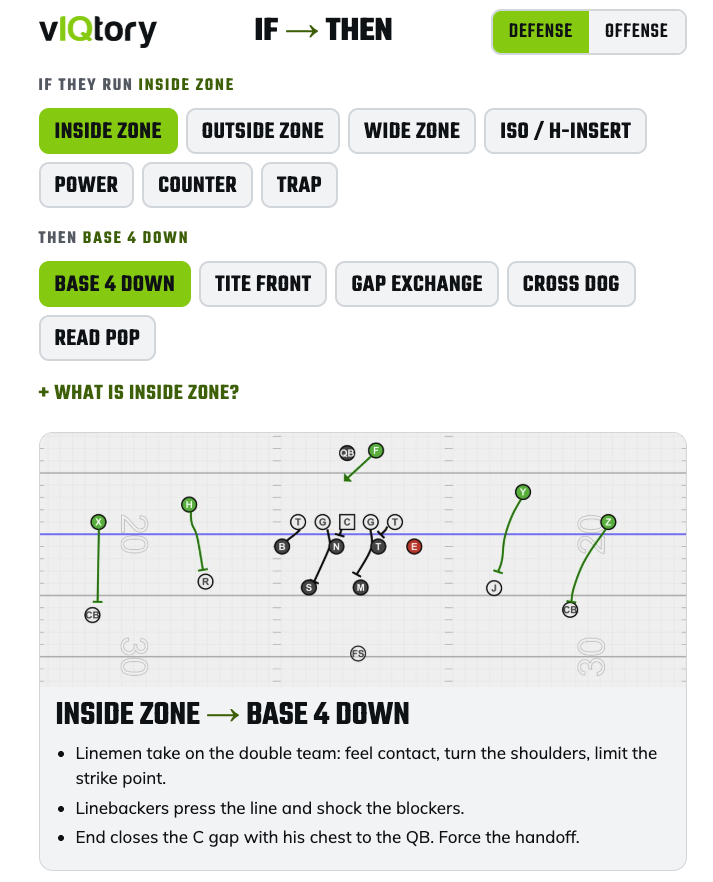
- Pick the front you see. Get the plays that beat it.
- Pick the play they run. Get the stunt that stops it.
- Tap-to-answer tool for the sideline, plus the PDF for your binder.
In this article, we’re going to show you how to maximize your quarterback’s throwing potential by teaching them the most optimized mechanics.
This is one piece of the quarterback install. The full progression is in the guide on how to coach quarterbacks.
Quarterback Mechanics

Think of throwing the football like a golf swing. If one part of the mechanics is off, it will completely change the contact point. It is no different when throwing a football.
If your lower half fires too fast, it will drag the arm. If you’re overstriding, you’ll lose a tremendous amount of whip from the elbow to the hand. When everything times out properly, the ball will “flick” off your quarterback’s hand.
Footwork
Footwork is everything in throwing a football. It’s what starts the throw and how you generate torque into your throws.
Remember, we are not baseball pitchers. We don’t have a mound or rubber to push off of. The quarterback needs to generate power from a flat surface. This means their hips need to be the main power driver into the throw.
To start, your quarterback should have his feet a little wider than shoulder-width apart. This will give them a great foundation to move the pocket, but also be able to generate power behind their throws.
Starting The Throw
When starting the throw, the quarterback should take a 6-inch step toward their target. Any less than 6 inches and their hips won’t fire; if they overstride, everything will fire late.
We are looking to trigger the kinematic sequence. Essentially, it’s just a fancy word for generating power from the ground and transferring it all the way to our wrist when the ball is thrown.
As the 6-inch step is taken, the hands should start to break apart. The front shoulder should stay tight as the back arm makes its way to its first “L”.
What we mean by the first L is this position right here:

When the ball is loaded up into this position, it allows for the body to time up the kinematic sequence properly to even distribute the power.
Think of it like this, you wouldn’t just raise the ball in the air and try to throw it down the field. You would cock it back first, then push it down the field. This first “L” is how we start to cock it back, so we can transfer the power.
If there is any energy leakage in this sequence, the ball will lose power. For example:
- Overstride – This will cause a disruption in the sequence, skipping right to the elbow or hand
- Not Getting To The First L – This is a common mistake quarterbacks have, as they will naturally just lift it up in the air. Remember, what goes up must come down.
These are the most common fixes a coach can make for his quarterback to begin getting him back into sequence.
Arm Angle
Once your quarterback is into the first “L”, he’ll then want to transition to a “C” shape path with his arm.
Some coaches will often phrase this as first L, second L, meaning the path of their arm after the first L should resemble a second L. The bigger coaching point is to make sure their arm doesn’t extend all the way back, and moves in a curved path that resembles a “C”.
This movement will time up properly as your hips start to fire from that initial 6-inch step.
Finish
Finishing the throw is often overcoached. Let the hand fall naturally to wherever the target is.
Some coaches may say “finish in your opposite pocket”. The reason this isn’t a great coaching cue is that the player may naturally try to pull the football down when they are trying to reach into their opposite pocket, which will affect the ball’s trajectory.
Let the arm fall naturally to wherever the target is.
Free Play Calling Guide
Know the exact play to call in every situation
- Pick the front you see. Get the plays that beat it.
- Pick the play they run. Get the stunt that stops it.
- Tap-to-answer tool for the sideline, plus the PDF for your binder.
To learn more quarterback techniques, continue reading here: