
The key to every great defense is to be able to play pullers and understand gap scheme fits. How you play pulling guards largely depends on the structure of your defense and where you want to force the ball to.
In this article, we’re going to show you how to play pullers and the techniques to best play them.
This is one piece of the defensive line install. The full progression is in the guide on how to coach the defensive line.
How To Play Pullers
There are three main ways to play pullers that we’re going to cover.
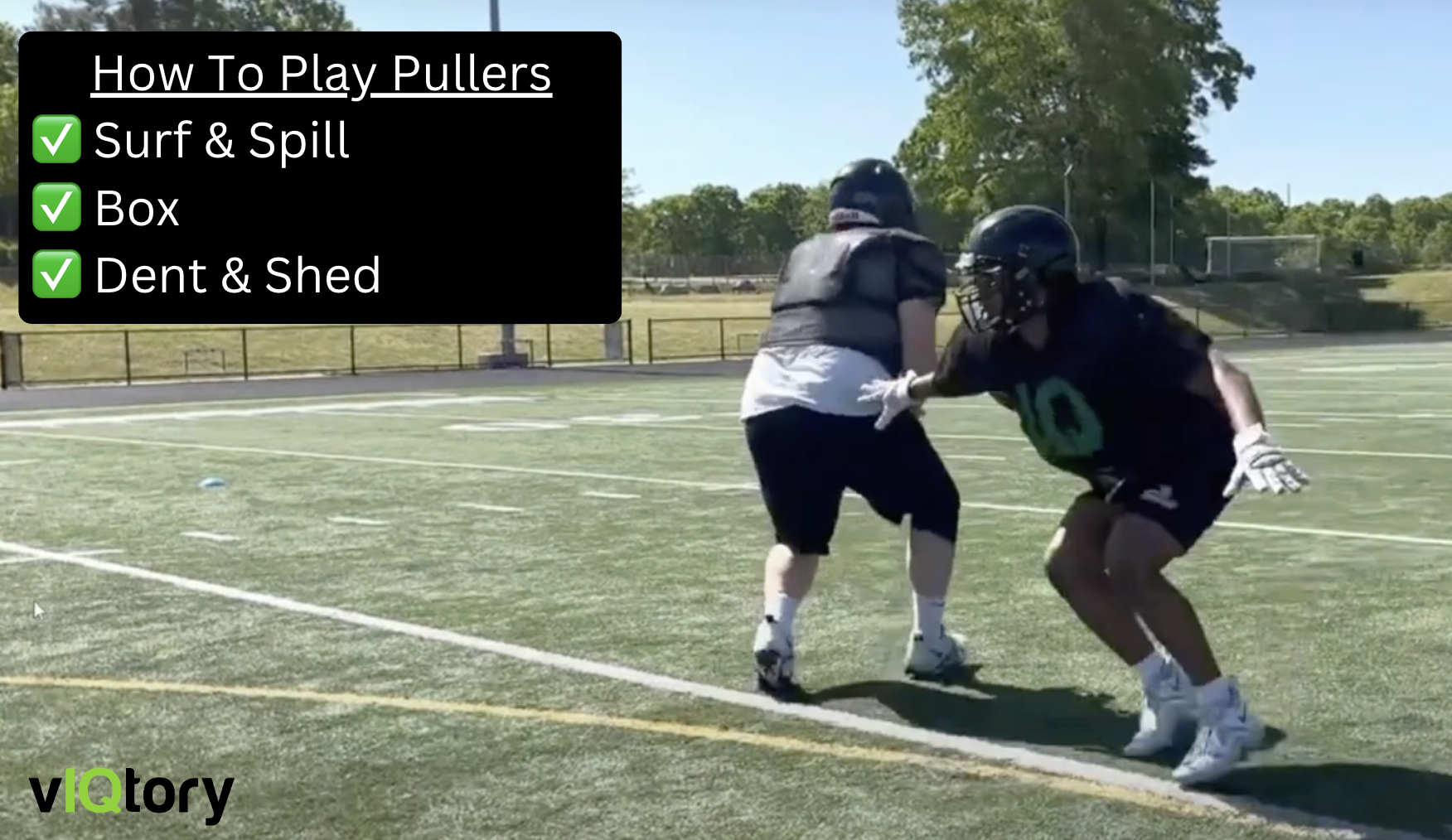
Spill
The point of doing the spill technique (also known as “wrong-arming”) is to get the running back to run horizontally (toward the sideline). The thought process of spilling the football is that you can run the ball down with your linebackers and safeties.
Spilling the football is similar to boxing the football, except when the puller gets to your defensive end, they will hit them on the inside shoulder, closing the hole, and forcing the running back to run outside of them.
Here are the fundamentals of spilling the football:
- Close Space – When the offensive tackle blocks down, close the space by staying square off of his hip. There should be no air between the offensive tackle who just down-blocked and the defensive end.
- Aim For The Inside Shoulder – Identify the inside shoulder of the pulling guard. Using the outside arm, swing it to the inside hip of the pulling guard. This will force the defensive end’s body to naturally cut off any running back lanes. In theory, it should also clog the hole so there is nowhere to run, forcing the running back to bounce it to the outside.
- Run The Feet – Once contact is made, the defensive end should continue to run their feet. If they stop their feet, they will cause a stalemate with the puller. A stalemate will often result in space being created, which will cause a lane.
Box
When playing a puller, the best way to force the ball back to the inside is box the football. When your defensive ends box the football, they are trying to force the ball carrier to the linebackers and defensive linemen who are to the inside. Fundamentally, here is how to box the football.
- Close Space – The first step in playing pullers is to close space. If your defensive ends just fly upfield as fast as they can, they are going to create space. Space creates holes. Your defensive ends want to minimize the space and squeeze down as much as possible. This will force the ball carrier to either bounce the football or put his head down and get little to no yards.
- Sink Hips – Upon contact from the pulling guard, the defensive end should sink their hips and get ready to deliver a strike. If they stand up tall, they will get completely displaced from their spot. Sinking their hips in an athletic position will help them absorb contact from the guard running at them
- Anchor Outside Leg – Anchoring the outside leg will help them absorb the initial contact and hold their ground. If the defensive end gets kicked out or displaced, a hole will form.
If boxing doesn’t work, teams will commonly restructure their defense for the spill technique.
Dent
The dent technique is a hybrid between spilling and boxing. With the dent technique, the defensive end will play the puller as if it’s a base block. This means they will take it on square, and be able to play both the outside and the inside of the puller.
The dent technique is great for bigger, more physical defensive ends who can make contact, knock back the pulling guard, and shed the block to make the tackle. Here is how to fundamentally do the dent technique.
- Close Space – Similar to the box and spill techniques, you’ll want to take as much space as you can. This will often help when your defensive end initiates contact with the puller; they won’t be at full speed.
- Contact – Make contact with the puller with the head to the inside. Make contact with the puller and create separation by locking out.
- Work Inside/Outside – Once contact is made, shed the puller inside or outside, depending on where the ball carrier is going.
Regardless of the technique you use, you’ll need to do one of these three techniques in order to play gap schemes properly.
For more defensive line techniques, read these articles: