
Teaching your players to protect themselves by lowering their shoulder is the most important skill a running back can attain. Safety is the number one key before we teach them how to run over or “truck” the defender.
Free Play Calling Guide
Know the exact play to call in every situation
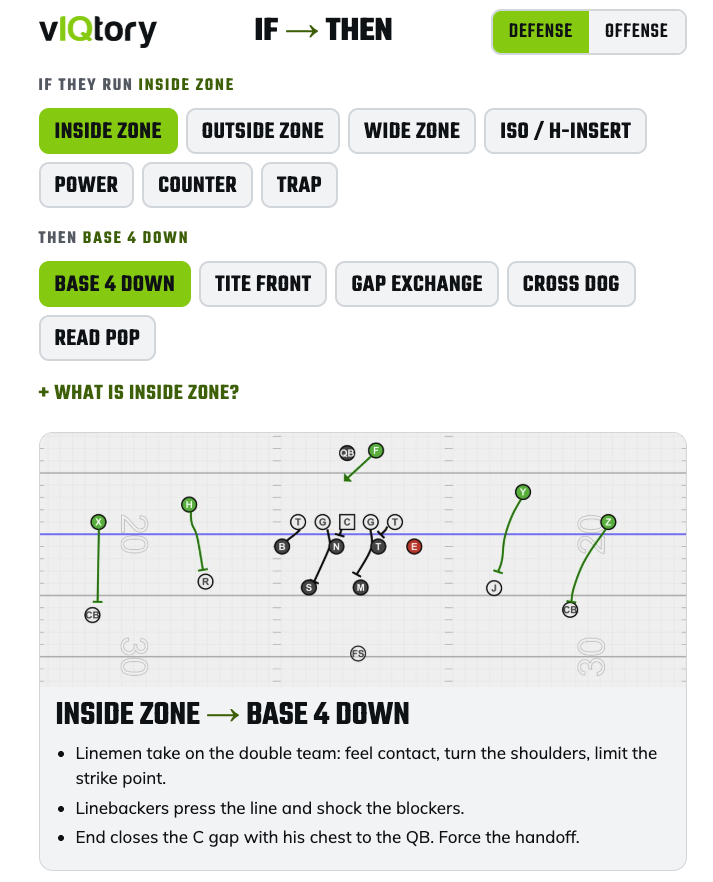
- Pick the front you see. Get the plays that beat it.
- Pick the play they run. Get the stunt that stops it.
- Tap-to-answer tool for the sideline, plus the PDF for your binder.
In this article, we’re going to teach you how you can coach your players to absorb contact and keep them safe.
This is one piece of the running back install. The full progression is in the guide on how to coach running backs.
How To Deliver Contact

The human body doesn’t want contact. It’s something that we avoid on a daily basis. It’s the reason why, as kids (and even adults), we get out of the way of a moving car.
Or when a baseball is thrown at us, we get out of the way. Contact hurts the body, and it naturally avoids pain.
So if your players are shy about absorbing contact, you just need to train their brains how to properly absorb it to minimize the strain on the body.
Lowering The Shoulder
The first thing to teach your players is to lower the shoulder, not the head. There’s a big difference. Naturally, when the shoulder lowers, the head will come with it. However, the head and facemask should still be looking forward. Dropping the head exposed the “crown” and the sides of the helmet, where impact to the temple could cause the most head injuries.
Lowering the shoulder and keeping the head up will help to protect your players from the head-to-head collisions that we try to avoid.
Keep The Legs Moving
Next, as a coach, you need to understand that any contact with the body will shock the nervous system. When the nervous system gets shocked, the legs naturally stop. This isn’t your player being “soft”, it’s a natural human reaction to contact.
Ideally, you’ll want your running backs to absorb the contact and keep their legs moving through contact.
This is why progression-based training is so important. If you just throw your players in a hitting drill, they will be timid and won’t know how to properly absorb contact. We recommend you work in this progression:
- Use a small shield that your players can run through. This will allow them to feel what something light feels like
- Next, put a coach behind the small shield that they need to run through
- After this, put a player from 1-2 yards away; they need to absorb contact through and keep running
- Last, put another player 3-4 yards away and run a low-impact drill that simulates a live environment
Notice we are walking through each progression, not just dropping them into a live environment and telling them “good luck!” This is what most coaches do, and nothing kills confidence faster than this.
The key is to build confidence and help your players develop a pain tolerance so their legs don’t stop.
Free Play Calling Guide
Know the exact play to call in every situation
- Pick the front you see. Get the plays that beat it.
- Pick the play they run. Get the stunt that stops it.
- Tap-to-answer tool for the sideline, plus the PDF for your binder.
To learn even more running back techniques, read here: