
Playing man coverage as a linebacker is different from man coverage as a defensive back. The reason is that linebackers often cover slot receivers and running backs, who are often quicker and faster than linebackers.
Free Play Calling Guide
Know the exact play to call in every situation
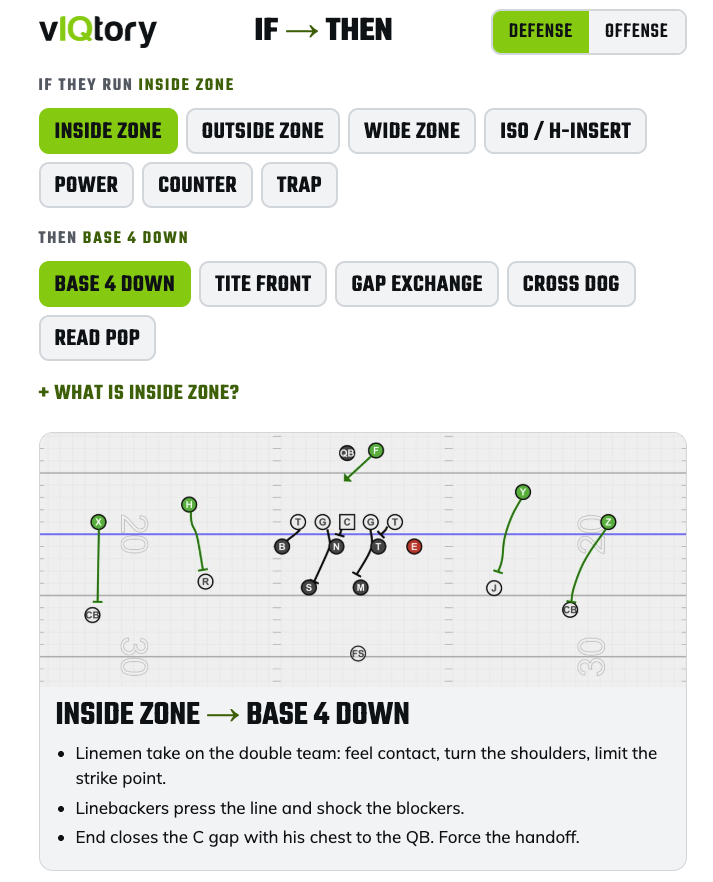
- Pick the front you see. Get the plays that beat it.
- Pick the play they run. Get the stunt that stops it.
- Tap-to-answer tool for the sideline, plus the PDF for your binder.
In this article, we’re going to show you how to play man coverage as a linebacker.
This is one piece of the linebacker install. The full progression is in the guide on how to coach linebackers.
Playing Man Coverage (Catch Press)

There are two ways to play man coverage as a linebacker. The first is called a catch-press technique.
The catch press technique requires the linebacker to use their strength (physicality) to knock the receivers off their mark. Below, we’re going to show you how to play catch press from the linebacker position.
Feet
To play the catch press technique, the linebacker should be in a stance that’s a little bit wider than shoulder-width. This will allow the linebacker to move horizontally to cut off any angles.
The best coaching point for the linebacker is to simulate like they are taking a charge in basketball. They want to position their bodies in a way that their nose is always on the inside shoulder of the receiver.
By putting ourselves in a position to take a charge, our should feet should be under us and our hips should be loaded up in a power position.
Hands
When striking a wide receiver who is accelerating, you want to catch to either:
Strike The Chest Plate – The aiming point for striking a receiver is in the dead center of their chest. This will knock them backwards and allow you to catch up to them as they run by you
Strike The Upper Shoulder Pad – If the linebacker is able to get a hold of the upper shoulder pad, you can torque the receiver sideways and redirect their hips. This is often done when the linebacker is moving laterally with the wide receiver, as they can match their momentum.
Once the linebacker makes contact with the receiver, they should then try to own their leverage.
Leverage
Leverage is very important when playing man coverage, because if you don’t have it, the receiver will own you both inside and outside. This is commonly known as stemming and stacking. Read more about wide receiver stemming here.
If the linebacker is playing man coverage on a running back or wide receiver, it’s anticipated that there is a blitz, a stunt, or some pressure toward the quarterback.
First, the linebacker wants to protect the inside. This is called playing with inside leverage. Align 2 yards to the inside, ensuring the linebacker can cut off the “easy” throw for the quarterback (the ones closest to him).
However, whatever leverage you play with means that you have a disadvantage to the other side. So if you have inside leverage, you will be at a disadvantage to the outside. Any out-breaking routes require the linebacker to bust his tail to break point and ensure the ball gets tackled.
Free Play Calling Guide
Know the exact play to call in every situation
- Pick the front you see. Get the plays that beat it.
- Pick the play they run. Get the stunt that stops it.
- Tap-to-answer tool for the sideline, plus the PDF for your binder.
For more linebacker technique articles, read here next: